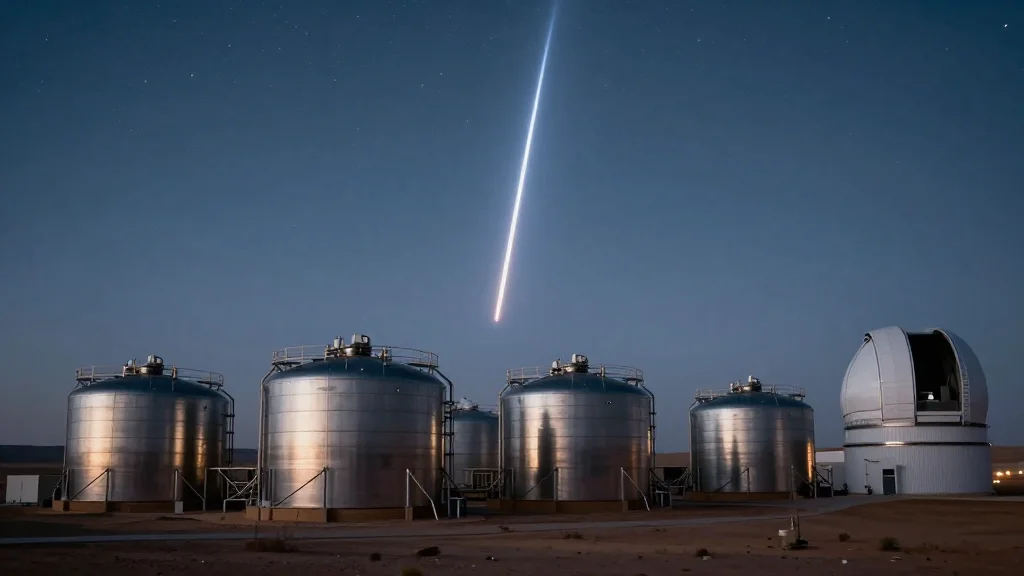
Penn State Study Says Ultra‑Heavy Nuclei May Power Record‑Breaking Cosmic Rays

Why It Matters
Understanding the true composition of ultra‑high‑energy cosmic rays is pivotal for pinpointing their astrophysical origins. If ultra‑heavy nuclei dominate, it narrows the field to only the most extreme cosmic environments, reshaping theories of particle acceleration and magnetic field dynamics on galactic scales. Moreover, confirming heavy nuclei would influence the design of next‑generation detectors, which must be optimized to differentiate between light and heavy primaries, thereby accelerating the resolution of a 60‑year‑old mystery. Beyond astrophysics, the discovery has implications for fundamental physics. Ultra‑high‑energy particles probe interactions at energies far beyond terrestrial accelerators, offering a natural laboratory for testing beyond‑Standard‑Model theories, such as Lorentz invariance violation or exotic particle decay channels. A shift in composition could alter the expected rates of such rare processes, guiding theoretical work in high‑energy physics.
Key Takeaways
- •Penn State team led by Kohta Murase suggests ultra‑high‑energy cosmic rays may be nuclei heavier than iron.
- •Simulations show ultra‑heavy nuclei lose energy more slowly than protons across intergalactic space.
- •The 2021 Amaterasu particle reached ~240 EeV, about 10 million times LHC energies.
- •Heavy‑nucleus composition points to extreme sources like magnetars or colliding neutron stars.
- •Upcoming observatories will test the hypothesis via improved Xmax and muon measurements.
Pulse Analysis
The Penn State study injects fresh momentum into a field that has long been hamstrung by ambiguous composition data. By anchoring the ultra‑high‑energy end of the spectrum to ultra‑heavy nuclei, the authors provide a concrete target for both theorists and experimentalists. Historically, the community has oscillated between proton‑dominant and mixed‑composition models, each with distinct implications for source energetics and magnetic field structures. This new heavy‑nucleus scenario forces a re‑calibration of source models, favoring environments where iron‑group elements can be stripped and accelerated—conditions that are rare but not unprecedented in the universe.
From a detector standpoint, the shift is equally profound. Current surface arrays and fluorescence telescopes were primarily tuned to distinguish between light and intermediate nuclei; heavy nuclei produce deeper, more muon‑rich air showers. The upcoming upgrades to the Telescope Array and the construction of the Southern Wide‑field Gamma‑ray Observatory will need to prioritize muon detection and high‑resolution Xmax reconstruction to validate Murase’s predictions. If confirmed, the field may see a rapid pivot toward building dedicated heavy‑nucleus observatories, akin to how neutrino astronomy blossomed after IceCube’s first detections.
Looking ahead, the study also opens a speculative but exciting avenue: using ultra‑heavy cosmic rays as probes of intergalactic magnetic fields. Their reduced energy loss implies longer mean free paths, making their deflection patterns sensitive to the large‑scale magnetic web. By mapping arrival directions of confirmed heavy nuclei, researchers could indirectly chart magnetic field strengths across cosmic voids, a measurement currently beyond reach. In short, the Penn State findings could catalyze a new sub‑discipline that blends particle astrophysics with cosmic magnetism, accelerating our understanding of the universe’s most energetic processes.
Penn State Study Says Ultra‑Heavy Nuclei May Power Record‑Breaking Cosmic Rays
Comments
Want to join the conversation?
Loading comments...