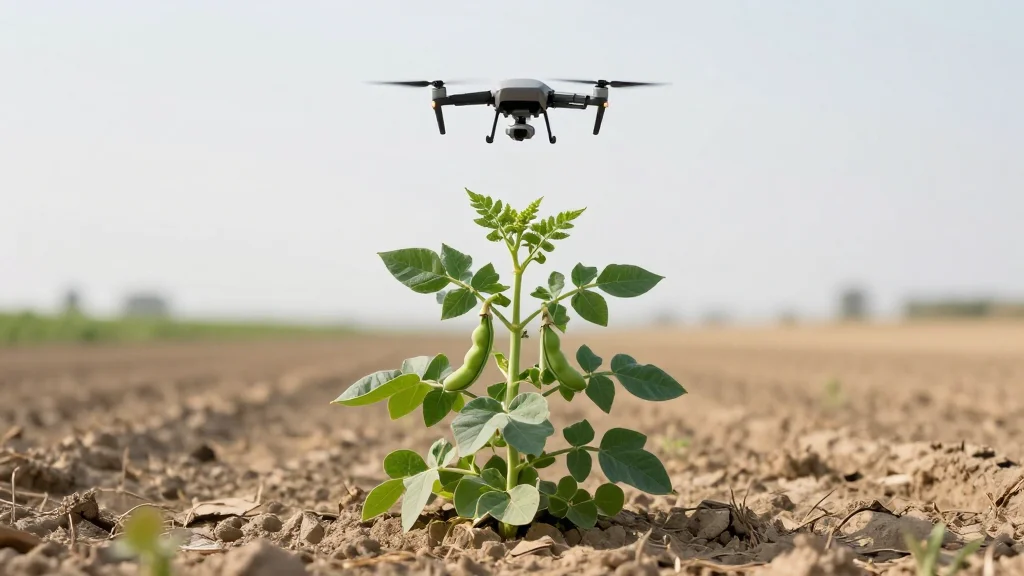
Phenomic Prediction in Drought-Stressed Faba Bean Across Spectral, Structural, and Fused Canopy Predictors
Why It Matters
The findings prove that multisensor phenomics can accelerate drought‑resilience breeding in faba bean, cutting the time and cost of traditional field evaluations. Early, accurate trait prediction enables breeders to secure higher‑protein legume yields for a climate‑challenged market.
Key Takeaways
- •Combined VI and 3D predictors yield highest accuracy for grain yield
- •3D-only models match or exceed VI for grain and pod number
- •Late‑season data best predicts integrative traits like biomass and yield
- •Trait‑specific windows needed for tiller count, kernel weight, WUE
Pulse Analysis
Faba bean’s role as a protein‑rich legume and a nitrogen‑fixing crop makes it a cornerstone of temperate agriculture, yet drought remains a persistent yield limiter. Traditional breeding for drought tolerance relies on labor‑intensive field measurements and multi‑environment trials, which struggle to capture the complex genotype‑by‑environment interactions that drive performance. Recent advances in high‑throughput phenotyping—particularly scanner‑based vegetation indices and three‑dimensional canopy reconstruction—offer a scalable alternative, converting raw canopy reflectance and structure into quantitative predictors that can be linked to agronomic outcomes.
In the presented research, researchers compared three predictor sets: VI alone, 3D traits alone, and a fused VI + 3D suite. The fused approach consistently outperformed the single‑sensor models for integrative traits such as total grain yield, water uptake, and straw biomass, achieving R² values up to 0.80 in late‑season assessments. Notably, for component traits like grain number and pod number, the 3D‑only models matched or surpassed the fused models, highlighting that structural information can capture specific yield components more directly than spectral data. Temporal strategy also mattered: cumulative data collected through the season improved accuracy for major traits, while narrower windows were essential for traits with tighter developmental windows, such as tiller count and water‑use efficiency.
These insights have immediate relevance for breeding pipelines. By integrating multisensor phenomics early in selection cycles, programs can prioritize drought‑tolerant genotypes before costly multi‑location trials, accelerating the delivery of resilient faba bean varieties to growers. Moreover, the methodology is transferable to other legumes and cereal crops facing water stress, positioning scanner‑based phenotyping as a cornerstone technology for climate‑smart agriculture and ensuring a stable supply of plant‑based protein for consumers.
Phenomic prediction in drought-stressed faba bean across spectral, structural, and fused canopy predictors
Comments
Want to join the conversation?
Loading comments...