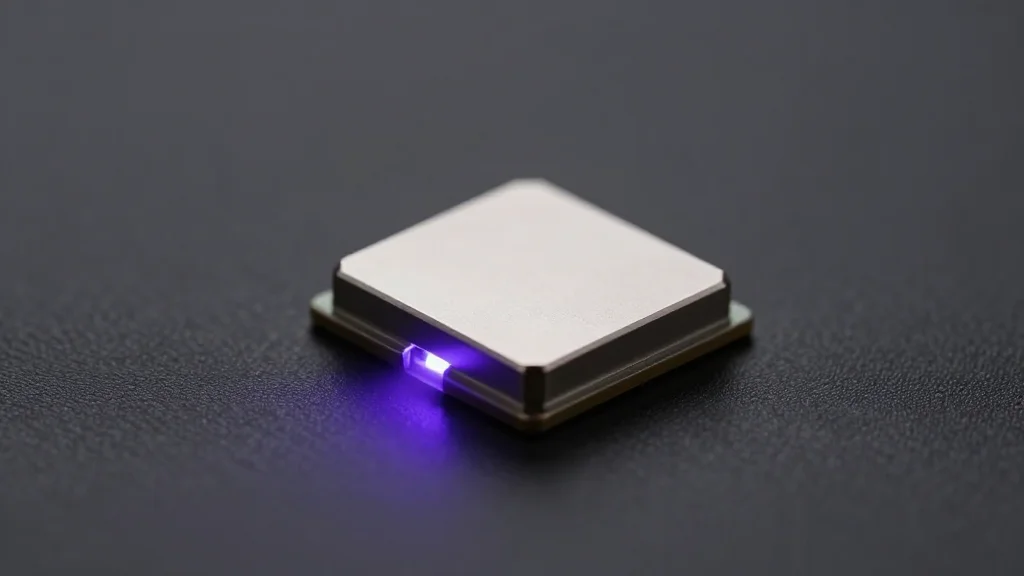
Photonic Chip Generates Milliwatt-Level UV Light, 100 Times Brighter than Before
Why It Matters
Milliwatt‑level on‑chip UV sources enable compact quantum processors and portable optical clocks, accelerating the shift from bulky laboratory equipment to scalable commercial systems.
Key Takeaways
- •Millimeter‑scale chip emits several milliwatts of UV light
- •UV output 100× brighter than previous integrated sources
- •Conversion uses red photons via sidewall‑poled lithium niobate waveguide
- •Spin‑off Sabratha aims to commercialize thin‑film lithium niobate chips
Pulse Analysis
Integrated photonics has long been dominated by infrared wavelengths, which suit fiber‑optic communications but fall short for applications that require visible or ultraviolet light. Sensing, quantum information processing, and next‑generation timing devices all depend on precise, high‑power UV photons, yet conventional on‑chip sources have struggled to deliver sufficient output. The new approach bridges this gap by leveraging mature red‑laser technology and converting it to UV directly on a chip, sidestepping the inefficiencies of external frequency‑doubling modules and opening a path toward fully integrated photonic systems.
The core of the breakthrough is a sidewall‑poled lithium niobate (SPLN) waveguide engineered at the nanometer scale. By periodically reversing the crystal orientation along a two‑centimeter waveguide and applying individualized voltages to roughly 10,000 electrodes, the researchers achieve quasi‑phase‑matched nonlinear conversion that fuses two red photons into a single UV photon. This precise electrode patterning—accurate to within fifty nanometers—boosts conversion efficiency dramatically, delivering UV power in the milliwatt range, a hundredfold increase over earlier prototypes. The thin‑film lithium niobate platform also offers low loss and high electro‑optic bandwidth, making it compatible with existing silicon photonic manufacturing pipelines.
The implications extend far beyond academic interest. Compact, high‑power UV sources are a missing component for scalable quantum computers, where trapped‑ion and neutral‑atom qubits often require UV manipulation. Optical atomic clocks, which can resolve gravitational potential differences, stand to become satellite‑compatible when housed on a chip. Commercialization efforts by the University of Twente spin‑off Sabratha aim to translate this technology into telecom and wireless communication products, promising a new class of integrated devices that combine the speed of photonics with the precision of UV light. As the ecosystem matures, the convergence of quantum, timing, and communication markets could accelerate the adoption of on‑chip UV photonics across multiple high‑value sectors.
Photonic chip generates milliwatt-level UV light, 100 times brighter than before
Comments
Want to join the conversation?
Loading comments...