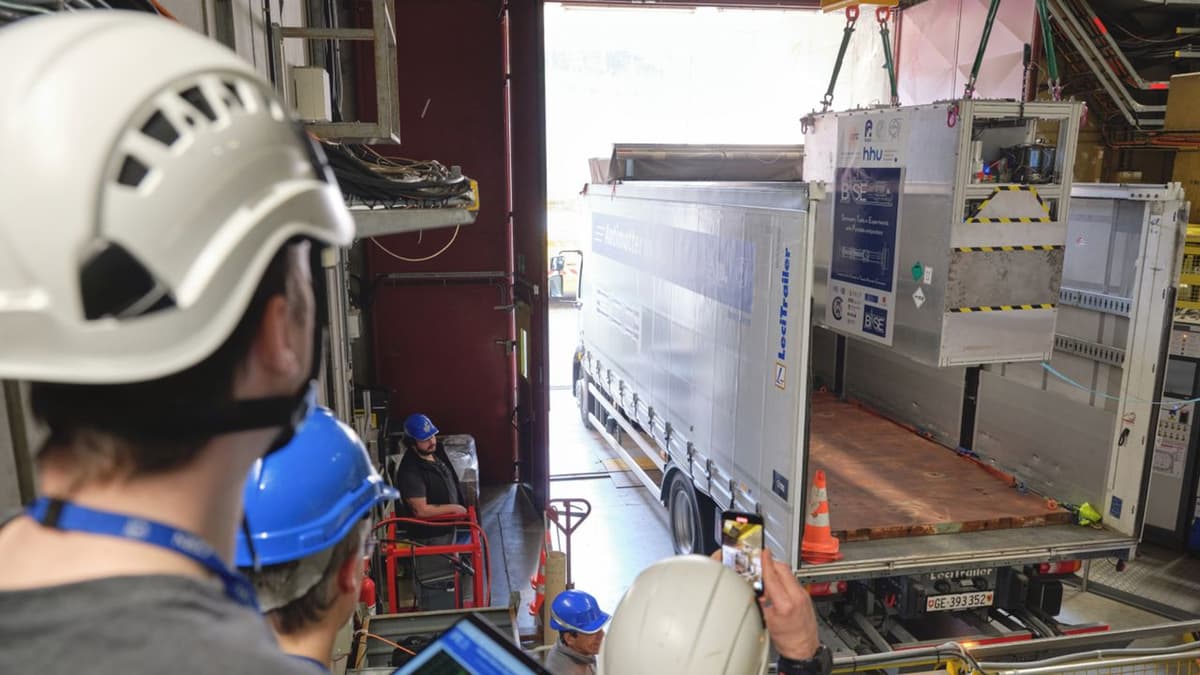
Physicists Moved Volatile Antimatter by Truck for the First Time Ever — Paving the Way for Groundbreaking New Research
Why It Matters
Enabling off‑site antimatter experiments could dramatically improve measurement precision, accelerating searches for physics beyond the Standard Model and helping explain why matter dominates the cosmos.
Key Takeaways
- •Antimatter moved 8 km by truck without loss
- •92 antiprotons stored in portable magnetic trap
- •Transport enables experiments in quieter labs across Europe
- •Could reveal matter‑antimatter asymmetry beyond Standard Model
- •CERN’s test poses negligible safety risk
Pulse Analysis
Antimatter, produced in CERN’s high‑energy collisions, has long been confined to ultra‑controlled environments because any contact with ordinary matter triggers instantaneous annihilation. The particles are typically held in magnetic and electric fields within a near‑perfect vacuum, a setup that is fragile even in a stationary lab. By demonstrating that this confinement can survive the mechanical stresses of a moving vehicle, the recent truck test challenges the long‑standing assumption that antimatter must remain on‑site, expanding the logistical possibilities for fundamental research.
The transport experiment hinged on a portable Penning‑trap system that housed 92 antiprotons. Engineers equipped the trap with robust magnetic shielding and vibration‑damping mounts, while continuous monitoring ensured the particles remained suspended throughout the 8‑kilometre circuit. Safety considerations were paramount; even the total antimatter inventory at CERN would generate only enough energy to power a single light bulb for minutes, making the risk negligible. The successful outcome proves that high‑precision antimatter studies can be conducted in facilities far removed from the noisy electromagnetic background of the collider complex.
Looking ahead, the ability to move antimatter to quieter labs—such as the Heinrich Heine University in Düsseldorf—could sharpen measurements of charge‑parity symmetry and other subtle effects that may reveal physics beyond the Standard Model. More accurate data on matter‑antimatter differences could illuminate why the early universe favored matter, a question central to cosmology and particle physics. For the broader scientific community, this breakthrough signals a new era of collaborative, cross‑institutional experiments that leverage specialized environments without sacrificing access to rare antimatter samples.
Physicists moved volatile antimatter by truck for the first time ever — paving the way for groundbreaking new research
Comments
Want to join the conversation?
Loading comments...