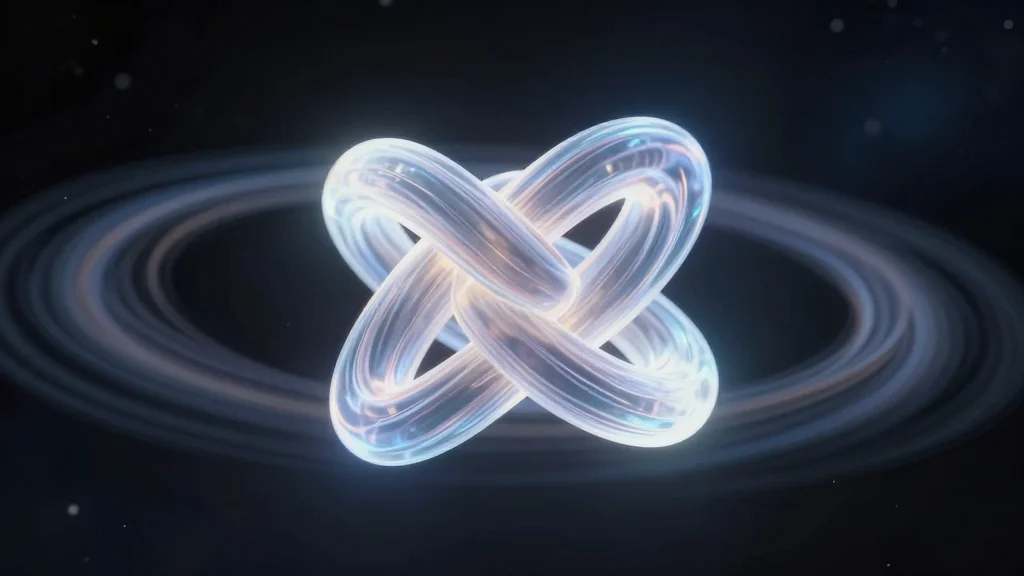
Physicists Reveal Hidden Knots in Spacetime, Hinting at New Topological Dynamics

Why It Matters
The identification of knotted structures in spacetime challenges the long‑standing view of gravity as a purely geometric deformation of a smooth manifold. By introducing topological invariants, the work provides new tools for probing the limits of Einstein’s theory, especially in regimes where classical descriptions break down. If these knots influence gravitational waveforms or black‑hole interiors, they could become a target for next‑generation detectors, offering a novel observational window into the deep structure of the universe. Beyond astrophysics, the concept of a “gravitational frozen‑in” effect may inspire cross‑disciplinary research, linking plasma physics, condensed‑matter theory, and quantum information. The topological approach could also inform efforts to quantize gravity, where preserving certain invariants is a key challenge. In sum, the study opens a fresh theoretical frontier that could ripple through multiple domains of fundamental physics.
Key Takeaways
- •Theoretical work shows Einstein’s equations allow stable knotted configurations in spacetime.
- •A conserved gravitational helicity provides a topological signature of spacetime dynamics.
- •Knotted structures could affect black‑hole mergers and gravitational‑wave signatures.
- •The framework draws parallels between gravitational fields and perfect conductors in plasma.
- •Future research aims to simulate observable effects and explore links to quantum gravity.
Pulse Analysis
The emergence of topological considerations in general relativity reflects a broader trend of seeking deeper mathematical structures to reconcile gravity with quantum mechanics. Historically, attempts to embed knot theory in physics have surfaced in fields like fluid dynamics and quantum field theory, but applying it to spacetime itself marks a notable shift. This work leverages the analogy between magnetic flux conservation and a hypothesized gravitational counterpart, suggesting that spacetime may possess hidden invariants that survive extreme curvature.
From a competitive standpoint, the paper positions itself against more conventional approaches that treat spacetime as a purely metric entity. By proposing conserved quantities such as gravitational helicity, the authors provide a concrete metric that could be tested against data from LIGO, Virgo, and upcoming detectors like the Einstein Telescope. If future simulations reveal distinct signatures, the community may see a surge in observational campaigns aimed at detecting these topological imprints.
Looking ahead, the real test will be whether the knotted framework can be integrated with leading quantum gravity candidates, such as loop quantum gravity or string theory. Both paradigms already incorporate elements of topology, but a unified description that accommodates the newly identified gravitational knots could accelerate progress toward a consistent theory of everything. Until empirical validation arrives, the proposal remains a provocative hypothesis that invites both enthusiasm and healthy skepticism.
Physicists Reveal Hidden Knots in Spacetime, Hinting at New Topological Dynamics
Comments
Want to join the conversation?
Loading comments...