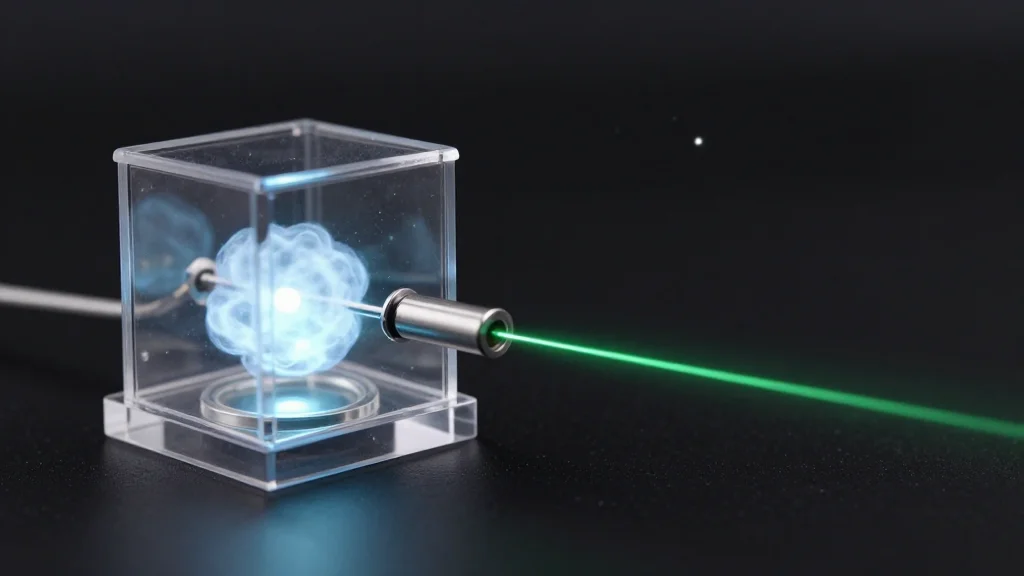
Physicists Revive 1990s Laser Concept to Propose a Next-Generation Atomic Clock
Why It Matters
A continuous superradiant laser could deliver the most stable frequency reference ever, reshaping precision timing, navigation, and fundamental‑physics measurements. Its immunity to environmental disturbances opens new possibilities for ultra‑sensitive sensors and next‑generation clocks.
Key Takeaways
- •Superradiant laser uses collective atomic emission, reducing environmental sensitivity
- •Adding a third ground state enables continuous operation, cutting heating
- •Predicted linewidth of ~100 µHz yields coherence length to Uranus
- •Tunable cavity pulling can approach zero, surpassing prior superradiant designs
- •Potential uses include ultra‑stable interferometry and future active nuclear clocks
Pulse Analysis
The race for ever‑more accurate timekeeping has long hinged on atomic clocks that lock laser frequencies to narrow atomic transitions. Conventional lasers rely on optical cavities to sustain coherence, making them vulnerable to temperature swings, vibrations, and other environmental noise. Superradiant lasers flip this paradigm by letting the atoms themselves generate a coherent beam, dramatically reducing susceptibility to external perturbations. However, early implementations were limited to brief pulses because the continuous pumping of atoms introduced heating that disrupted the collective emission.
The breakthrough presented by Reilly, Jäger and colleagues lies in expanding the atomic model from a simple two‑level system to a three‑level configuration. This extra ground state separates the pumping and decay pathways, allowing a collective pump that adds far less thermal energy while maintaining steady‑state lasing. Theoretical calculations using barium atoms predict a linewidth near 100 µHz—orders of magnitude narrower than any existing optical laser—yielding a coherence length that stretches to the orbit of Uranus. Moreover, the scheme offers tunable cavity pulling that can be driven to near‑zero, eliminating a major source of frequency drift that has plagued prior designs.
Beyond redefining the limits of clock precision, such a laser could become a cornerstone for ultra‑stable optical interferometers. In gravitational‑wave observatories, for example, a light source immune to environmental frequency shifts would isolate spacetime ripples as the sole cause of phase variations, boosting detector sensitivity. The same principles may enable active nuclear clocks, which exploit nuclear transitions for even higher stability. As industries ranging from satellite navigation to quantum communication demand tighter timing tolerances, the commercial and scientific stakes for deploying a continuous superradiant laser are substantial.
Physicists revive 1990s laser concept to propose a next-generation atomic clock
Comments
Want to join the conversation?
Loading comments...