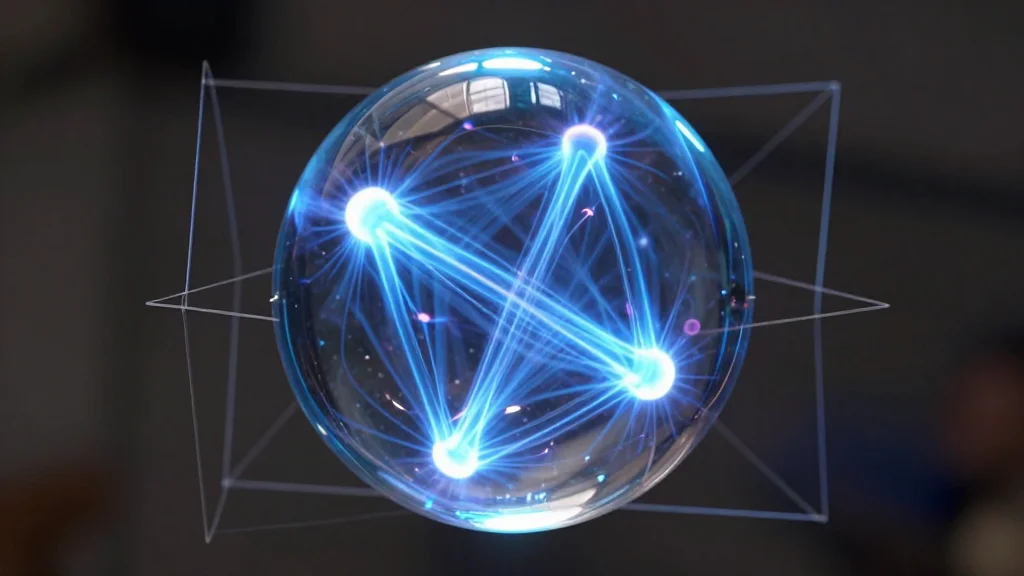
Physicists Uncover Inviolable 'Frozen‑In' Rules in Einstein’s Spacetime

Why It Matters
The identification of immutable geometric constraints within Einstein’s spacetime bridges a long‑standing gap between general relativity and plasma physics, two fields that have historically operated in separate theoretical silos. By providing a concrete set of topological invariants, the research offers a new lens through which to interpret the most violent astrophysical phenomena, from black‑hole mergers to the early universe’s turbulent epochs. This could accelerate the development of more accurate gravitational‑wave templates, directly impacting the sensitivity and scientific return of multimessenger astronomy. Beyond observational astronomy, the frozen‑in framework may inspire novel approaches to quantum gravity. If spacetime possesses built‑in, conserved structures, they could serve as footholds for reconciling general relativity with quantum mechanics, guiding future theories that aim to describe gravity at the Planck scale.
Key Takeaways
- •Physicists at Columbia University discovered "frozen‑in" gravitational structures that remain unchanged during extreme spacetime distortions.
- •The study reformulates Einstein’s field equations using nonlinear electrodynamics, enabling plasma‑physics analogies.
- •Conserved topological quantities—gravitational flux and helicity—were identified as new invariants.
- •Implications include more reliable simulations of black‑hole mergers and improved gravitational‑wave predictions.
- •Next steps involve peer‑reviewed publication and validation against upcoming LIGO/Virgo data.
Pulse Analysis
The frozen‑in paradigm marks a conceptual shift comparable to the introduction of the cosmological constant in the early 20th century. By anchoring spacetime dynamics to topological invariants, researchers gain a predictive scaffold that could reduce the reliance on brute‑force numerical methods, which have historically been the bottleneck in modeling strong‑field gravity. This aligns with a broader trend of cross‑disciplinary fertilization, where ideas from condensed‑matter and plasma physics are increasingly informing cosmological theory.
Historically, attempts to impose additional structure on Einstein’s equations have met resistance, often because they risk over‑constraining a theory celebrated for its flexibility. However, the plasma analogy offers a physically motivated condition—an idealized Ohm’s law—that naturally emerges in highly conductive media. If future simulations confirm that spacetime behaves analogously under realistic astrophysical conditions, the community may adopt these constraints as standard boundary conditions in relativistic codes, streamlining the pipeline from theory to observation.
Looking ahead, the true test will be empirical. Gravitational‑wave observatories are entering an era of unprecedented sensitivity, and the next generation of detections will provide the data needed to validate—or refute—the frozen‑in hypothesis. Should the invariants prove observable, they could become a new diagnostic toolkit for probing the interior dynamics of merging black holes, potentially revealing subtle deviations from general relativity that hint at new physics.
Physicists Uncover Inviolable 'Frozen‑In' Rules in Einstein’s Spacetime
Comments
Want to join the conversation?
Loading comments...