Physics-Guided Network Eliminates Honeycomb Artifacts in Fiber Endoscopy
Why It Matters
Clear, artifact‑free images from ultrathin fiber endoscopes enable more accurate minimally invasive diagnoses and faster procedural guidance, expanding the utility of fiber‑optic probes across medicine and industry.
Key Takeaways
- •SGARNet uses frequency-domain SpectralGate to suppress honeycomb artifacts.
- •Multi‑core fiber probes achieve ~2.1 µm resolution, matching core size.
- •Physics‑guided design improves generalization from synthetic to real samples.
- •Real‑time processing enables immediate feedback in clinical and industrial settings.
- •Artifact removal enhances diagnostic clarity for tissue imaging and inspection.
Pulse Analysis
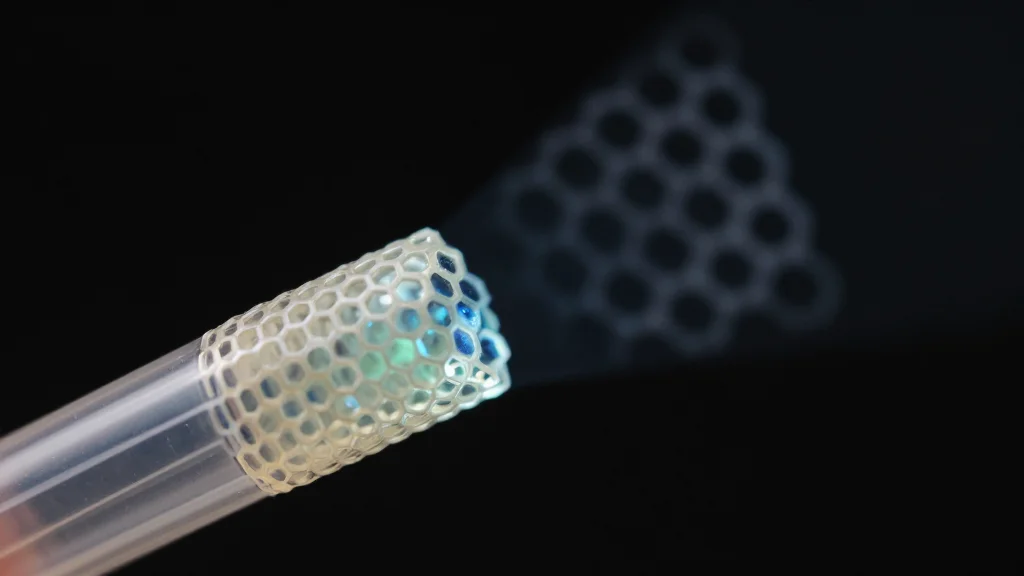
The demand for ever‑smaller endoscopic probes has driven the adoption of multi‑core fibers, which replace bulky distal optics with a dense array of individual cores. While this architecture shrinks probe diameters to a few hundred micrometers, the hexagonal arrangement of the cores creates a periodic sampling pattern that manifests as honeycomb artifacts in reconstructed images. These artifacts obscure fine structural details, limiting the diagnostic value of fiber‑based imaging in both medical and industrial contexts. Conventional post‑processing—ranging from simple interpolation to generic deep‑learning models—has struggled to fully remove the distortion without sacrificing image fidelity or requiring extensive labeled datasets.
SGARNet tackles the problem by embedding physical insight directly into the neural network. The researchers first mapped the artifact’s signature in the Fourier domain, identifying discrete peaks aligned with the core lattice. Their SpectralGate module acts as a frequency‑domain filter, attenuating only those peaks while leaving the surrounding spectrum untouched. This targeted approach preserves critical high‑frequency information, enabling the network to restore colors, contrast, and sub‑micron structures without the over‑smoothing typical of blind deep‑learning methods. The lightweight architecture also keeps computational load low enough for real‑time deployment.
The practical impact of SGARNet is immediate. In laboratory tests, the system resolved line pairs as fine as 2.1 µm on the USAF 1951 target and produced clear images of nerve tissue, mushroom cross‑sections, and woody stems, demonstrating robustness across diverse sample types. Real‑time artifact suppression opens the door to live surgical navigation and on‑the‑fly industrial inspection, where delayed feedback is unacceptable. By marrying optics theory with modern AI, SGARNet sets a new benchmark for interpretable, generalizable image restoration in ultra‑compact endoscopy.
Physics-Guided Network Eliminates Honeycomb Artifacts in Fiber Endoscopy
Comments
Want to join the conversation?
Loading comments...