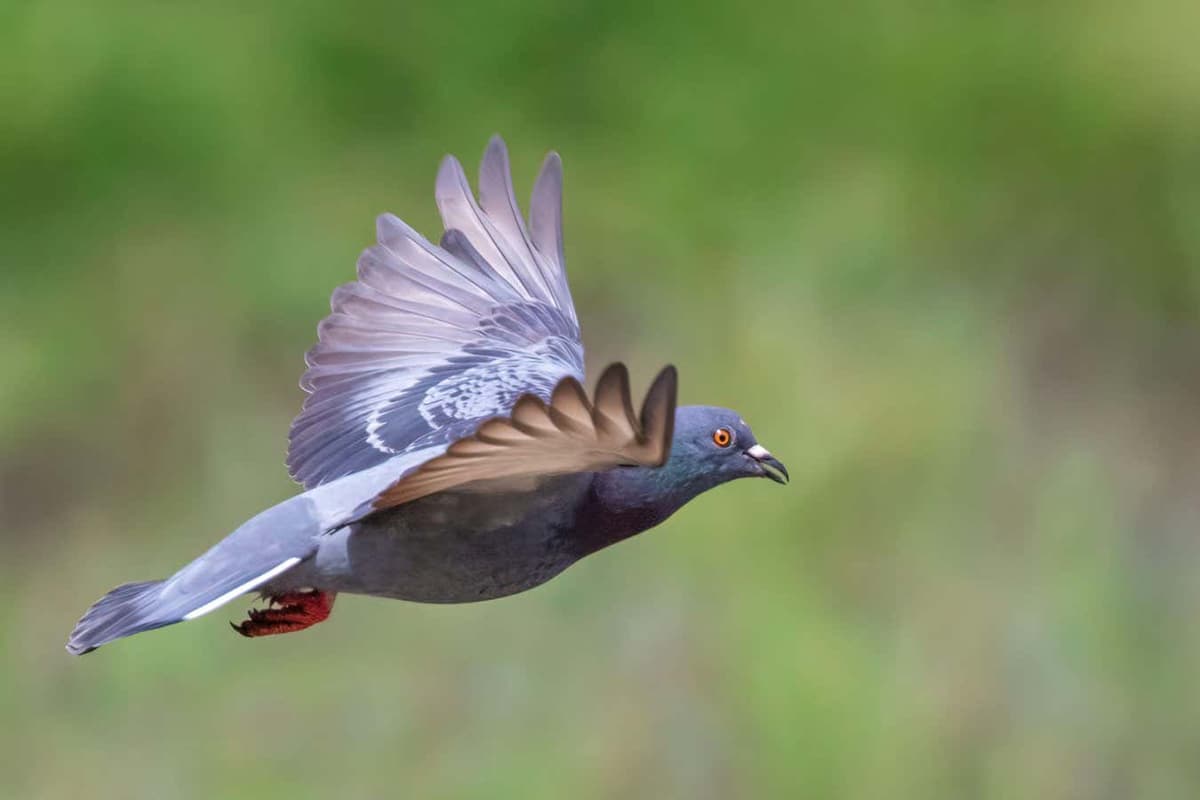
Pigeons Lock Their Eyes in Place when They Are Flying
Why It Matters
Understanding how pigeons stabilize their gaze reveals fundamental mechanisms of aerial navigation and sensory integration, informing both biology and bio‑inspired flight technologies. It also highlights a trade‑off between motion stability and predator awareness that could affect urban bird ecology.
Key Takeaways
- •Pigeons lock eyes forward during flight, moving less than 1°
- •Fixed eye position aligns with vestibular system for motion stabilization
- •Reduced eye movement may lower brain processing load in fast flight
- •Locking eyes narrows 340° view, creating blind spot behind pigeons
- •Study used lightweight head‑mounted rig on six indoor and three outdoor pigeons
Pulse Analysis
The discovery that pigeons keep their eyes fixed while soaring challenges long‑standing assumptions about avian vision in motion. Prior research focused on head movements and saccades in stationary birds, but the Caltech team’s miniature mirror‑camera system captured real‑time ocular data during flight for the first time. By tracking pupil dilation and eye orientation across indoor and outdoor courses, researchers confirmed a near‑static gaze that aligns with the horizontal axis of the vestibular system, a sensory network crucial for balance and spatial orientation.
From an engineering perspective, the locked‑eye strategy offers a natural solution to the problem of visual overload during high‑speed travel. By minimizing eye rotations, pigeons likely reduce the computational burden on their visual cortex, allowing faster processing of motion cues essential for navigation. This aligns with theories that sensory systems prioritize stability over breadth when rapid decisions are required. The behavior also suggests an evolutionary compromise: sacrificing part of the 340‑degree panoramic view to gain a steadier perception of self‑movement versus external motion, which could be advantageous in cluttered urban environments where obstacles constantly shift.
The broader implications extend to other bird species and even autonomous aerial vehicles. If predators like peregrine falcons also stabilize their gaze during pursuit, the principle may be a common adaptation for high‑velocity hunting. For robotics, mimicking this fixed‑gaze approach could improve drone stability and reduce processing latency. Future studies will need to explore how eye‑locking varies with altitude, flock dynamics, and threat levels, potentially reshaping our understanding of avian sensory ecology and informing next‑generation bio‑inspired flight designs.
Pigeons lock their eyes in place when they are flying
Comments
Want to join the conversation?
Loading comments...