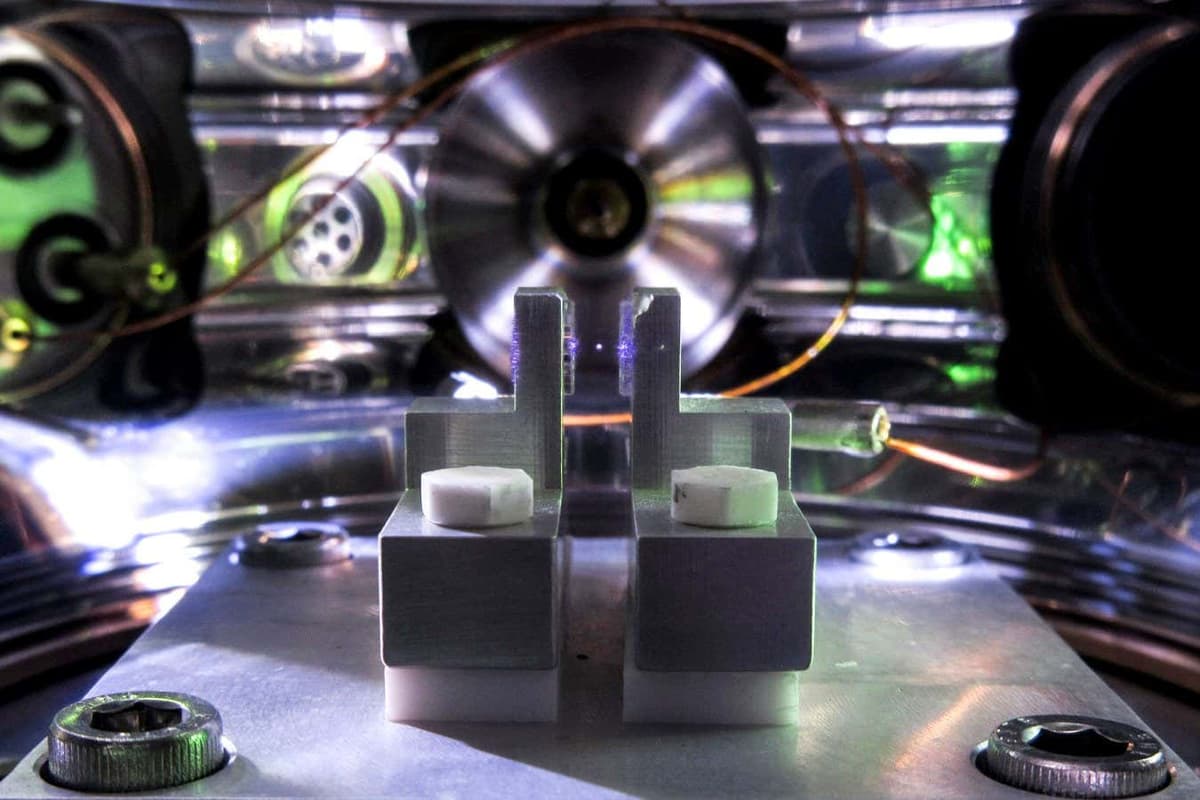
Pressure From Individual Particles Measured for the First Time
Why It Matters
Single‑particle pressure measurement unlocks ultra‑sensitive detection of rare particle interactions, accelerating dark‑matter and neutrino research while enhancing vacuum‑based technologies.
Key Takeaways
- •Optical trap measures pressure from individual particles for first time
- •100‑nm silica bead held by laser enables femto‑newton force sensitivity
- •Technique could detect dark‑matter candidates like sterile neutrinos
- •Improves vacuum‑experiment modeling by accounting for single‑particle impacts
- •Opens new avenues for nanoscale pressure sensors in biotech and MEMS
Pulse Analysis
The new sensor leverages optical‑tweezer technology, a method that uses tightly focused laser light to levitate microscopic objects. By trapping a 100‑nanometre silica sphere, researchers can monitor its minute displacement caused by the momentum transfer of a single gas molecule or photon. This displacement translates into a pressure reading with unprecedented resolution, reaching the femto‑newton range—orders of magnitude finer than traditional manometers. The achievement marks a milestone in nanomechanical metrology, where controlling and measuring forces at the atomic scale is essential for both fundamental science and emerging applications.
Beyond the laboratory, the ability to detect pressure from individual particles could transform the hunt for dark matter and sterile neutrinos. Current detectors rely on bulk interactions that produce faint, collective signals, often buried in background noise. A sensor that isolates single‑particle events offers a cleaner, more direct observation channel, potentially revealing the weakly interacting particles that have so far evaded detection. By integrating this technology into ultra‑high‑vacuum chambers, physicists can better quantify residual gas impacts that mimic or mask genuine particle events, sharpening the sensitivity of next‑generation experiments.
The implications extend to industry as well. Ultra‑sensitive pressure sensors are valuable in semiconductor manufacturing, aerospace, and biomedical devices where minute force changes can indicate system health or process deviations. The optical‑trap approach is contact‑free, reducing wear and contamination, and could be miniaturized for on‑chip integration. As the technique matures, it may spawn a new class of nanoscale transducers, driving innovation across nanotechnology, MEMS, and quantum‑sensor markets. Continued development will focus on scaling the bead size, improving laser stability, and coupling the sensor with electronic readouts for real‑time monitoring.
Pressure from individual particles measured for the first time
Comments
Want to join the conversation?
Loading comments...