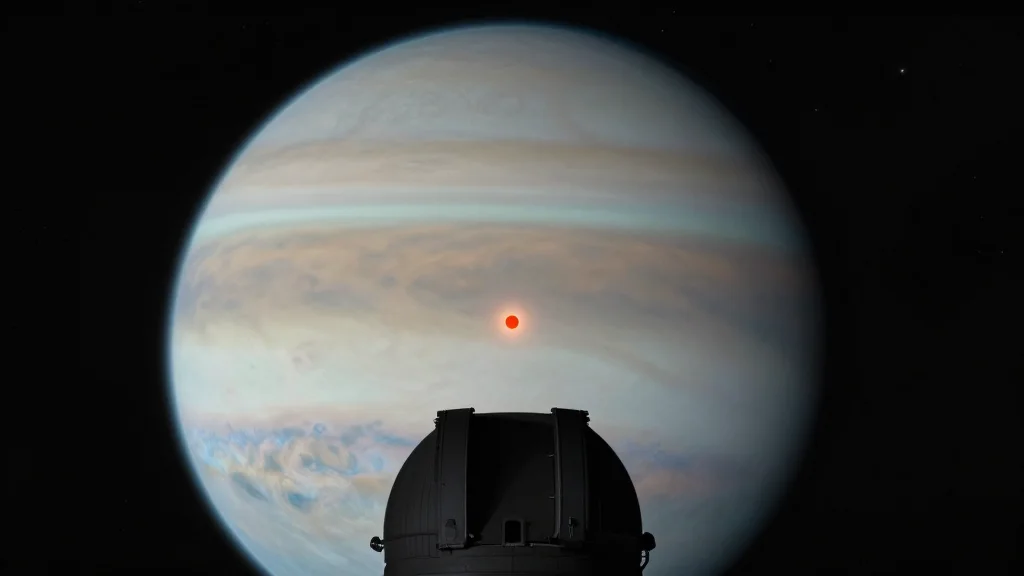
'Puffy' Super-Neptune Emerges 383 Light-Years Away with a Density of Just 0.4 G/Cm³
Why It Matters
The discovery refines models of planet formation and migration, highlighting how metallicity and stellar irradiation can produce extreme low‑density worlds, and it earmarks TOI‑1883 b as a prime target for atmospheric spectroscopy.
Key Takeaways
- •TOI‑1883 b mass 13.7 Earth masses, radius 5.65 Earth radii.
- •Density 0.4 g/cm³ makes it the puffiest super‑Neptune around M dwarfs.
- •Lies in Neptunian desert ridge, challenging migration models.
- •Host star’s high metallicity may have limited gas accretion.
- •Findings guide target selection for JWST atmospheric studies.
Pulse Analysis
The detection of TOI‑1883 b underscores the rapid maturation of exoplanet science, where space‑based surveys like TESS flag candidates and ground‑based facilities such as Subaru confirm their bulk properties. By combining precise radial‑velocity measurements with multi‑band transit photometry, researchers can resolve the mass‑radius relationship for planets that sit at the boundary between super‑Earths and gas giants, offering a clearer picture of planetary composition trends across different stellar hosts.
TOI‑1883 b’s placement within the Neptunian desert—a region historically devoid of short‑period, mid‑size planets—forces a rethink of migration and atmospheric loss theories. The planet’s inflated envelope suggests it migrated inward through the protoplanetary disk before intense extreme‑UV radiation from its host star stripped away lighter gases. Moreover, the host’s super‑solar metallicity (+0.32 dex) may have throttled runaway gas accretion, preventing a transition to a full‑blown gas giant. These dynamics illustrate how stellar chemistry and irradiation jointly sculpt planetary outcomes.
For investors and industry stakeholders, the find signals a lucrative niche for next‑generation observatories. The planet’s low density and bright host make it an ideal candidate for James Webb Space Telescope and upcoming ground‑based spectrographs to probe atmospheric composition, cloud decks, and potential biosignature gases. Such high‑value targets drive demand for advanced instrumentation, data‑processing pipelines, and collaborative missions, reinforcing the commercial momentum behind exoplanet characterization platforms.
'Puffy' super-Neptune emerges 383 light-years away with a density of just 0.4 g/cm³
Comments
Want to join the conversation?
Loading comments...