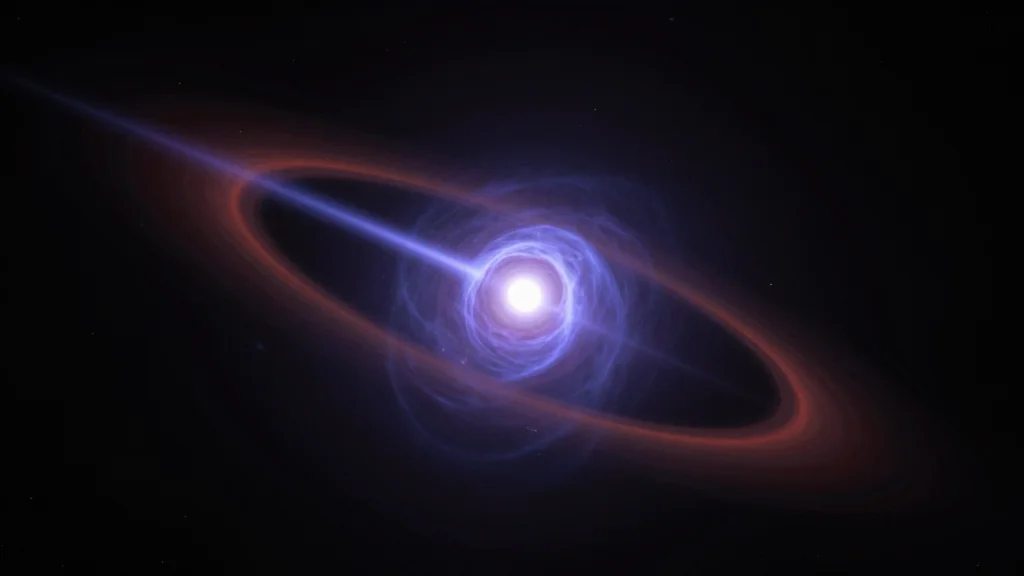
Pulsar Wind Nebula Inside Supernova Remnant Explored with Chandra
Why It Matters
These results sharpen models of young pulsar wind nebulae by revising age and velocity estimates and demonstrating that low‑magnetization PWNe can still accelerate particles to near‑PeV energies, influencing theories of cosmic‑ray origins.
Key Takeaways
- •Chandra images reveal 20‑arcsecond jet bending south‑west
- •Pulsar velocity limited to <200 km/s, lower than previous estimates
- •PWN magnetic field measured at 1.4–3.2 µG, unusually low
- •Electron cutoff energy reaches 0.2–0.3 PeV, near PeV regime
- •Low radiative efficiency indicates energy primarily fuels particle acceleration
Pulse Analysis
Pulsar wind nebulae (PWNe) are among the most energetic particle accelerators in the Galaxy, yet their internal dynamics remain poorly constrained. The CTA 1 system, a composite supernova remnant about 4,600 light‑years away, offers a rare laboratory where a radio‑quiet pulsar powers a bright X‑ray nebula. By combining new deep Chandra exposures with archival data and complementary Fermi‑LAT gamma‑ray observations, researchers have mapped the nebular structure with unprecedented clarity, revealing a compact jet, counter‑jet, and torus that together trace the flow of relativistic wind from the pulsar.
The morphological details carry significant physical meaning. The ~20‑arcsecond jet’s pronounced bend suggests interaction with either the surrounding supernova ejecta or the reverse shock propagating inward, a process that can reshape the nebula over thousands of years. Moreover, the measured transverse velocity of PSR J0007+7303—under 200 km s⁻¹—contrasts sharply with earlier, higher estimates derived from its offset within the remnant. This slower speed implies either an older true age than the characteristic 14 kyr or an asymmetric expansion of CTA 1, prompting a reassessment of the remnant’s dynamical history.
Spectral modeling adds another layer of insight. The PWN exhibits a hard X‑ray spectrum with a low radiative efficiency, while broadband spectral‑energy distribution fitting points to a magnetic field of only 1.4–3.2 µG. Such weak magnetization, combined with an electron cutoff near 0.3 PeV, demonstrates that even low‑magnetization PWNe can accelerate particles to energies approaching the cosmic‑ray knee. This challenges conventional wisdom that strong magnetic fields are prerequisite for PeV acceleration and underscores the CTA 1 nebula as a critical testbed for theories of high‑energy astrophysical processes. Future multi‑wavelength campaigns and next‑generation X‑ray missions will likely refine these parameters further, deepening our grasp of how pulsar winds shape their environments and contribute to the Galactic cosmic‑ray budget.
Pulsar wind nebula inside supernova remnant explored with Chandra
Comments
Want to join the conversation?
Loading comments...