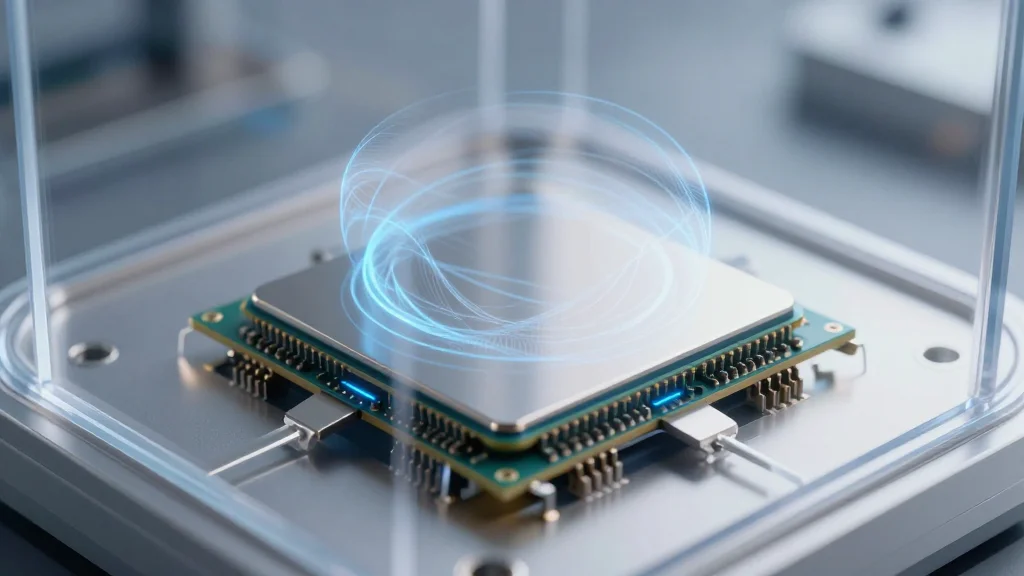
Q&A: How Researchers Are Building Next-Gen Quantum Computers
Why It Matters
An integrated stack and AI‑driven control can overcome key scaling bottlenecks, hastening quantum advantage for scientific and commercial workloads.
Key Takeaways
- •QubiC provides open‑source control for superconducting qubits at AQT.
- •Low‑noise wiring needed to scale beyond a few thousand qubits.
- •AI‑driven QubiCML aims to improve quantum error‑correction readout.
- •Berkeley Lab links cryogenics, materials, and supercomputing for full‑stack development.
Pulse Analysis
Quantum computing is poised to reshape fields from drug discovery to cosmology, but the technology remains fragile. Superconducting qubits must operate at millikelvin temperatures inside dilution refrigerators, while precise microwave pulses from room‑temperature electronics orchestrate quantum gates. Any noise—thermal, electromagnetic, or material‑based—quickly degrades coherence, limiting computational depth. Consequently, researchers now view the processor, cryogenic infrastructure, wiring, and control software as a single stack that must be co‑engineered to achieve reliable, scalable performance. These interdependencies drive a shift toward co‑design across disciplines.
At Lawrence Berkeley National Laboratory’s Advanced Quantum Testbed, the team is tackling each layer of that stack. The open‑source QubiC platform synchronizes microwave pulses with sub‑nanosecond precision, while novel low‑noise coaxial cables reduce thermal load and cross‑talk as qubit counts climb into the thousands. Researchers are also prototyping QubiCML, an AI‑assisted readout that leverages machine‑learning models to identify and correct errors in real time. By integrating cryogenics, materials science, and high‑performance computing, Berkeley Lab creates a testbed that mirrors commercial quantum‑hardware pipelines.
The holistic approach championed by Berkeley Lab is critical for the transition from noisy intermediate‑scale quantum (NISQ) devices to fault‑tolerant machines that can outperform classical supercomputers. Error‑corrected processors will rely on massive classical workloads to decode syndromes and apply corrective gates, creating a new class of hybrid quantum‑classical workloads. As industry partners adopt the stack components—cryogenic platforms, control electronics, and AI‑driven software—the ecosystem accelerates toward commercially viable quantum services in finance, materials design, and national security. Ultimately, the lab’s full‑stack roadmap shortens the timeline for quantum advantage and expands the market potential for next‑generation computing.
Q&A: How researchers are building next-gen quantum computers
Comments
Want to join the conversation?
Loading comments...