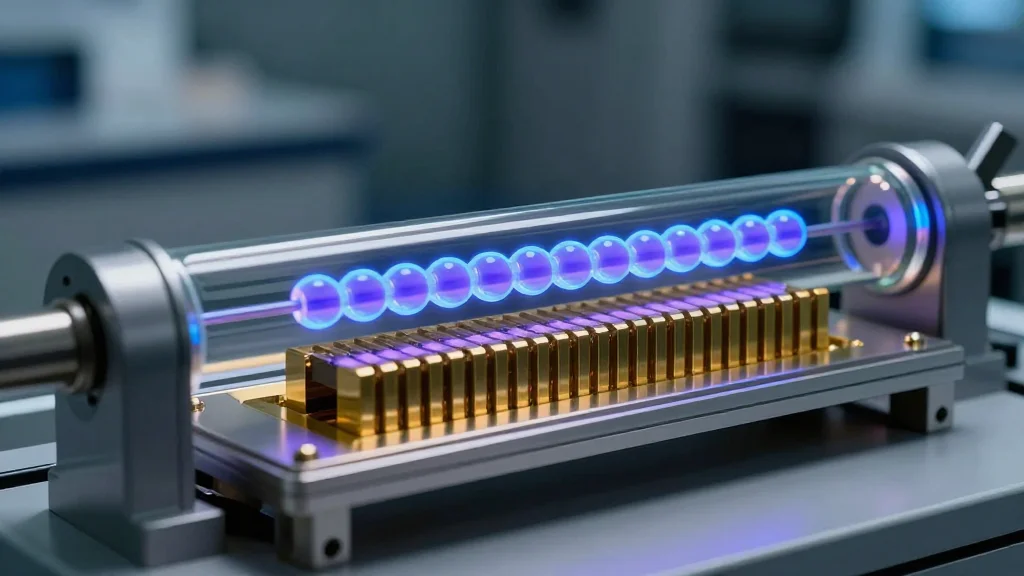
Quantum Computing without Interruptions
Why It Matters
Eliminating mid‑circuit measurements reduces latency and error sources, accelerating the path toward scalable quantum computers and strengthening hardware platforms where measurement is a bottleneck.
Key Takeaways
- •Demonstrated measurement‑free fault‑tolerant quantum algorithm.
- •Ran Grover’s search on three logical qubits.
- •Eliminates mid‑circuit measurements, reducing latency and errors.
- •Uses coherent error processing via standard quantum gates.
- •First proof‑of‑concept on trapped‑ion quantum processor.
Pulse Analysis
Mid‑circuit measurements have long been the Achilles’ heel of quantum error correction, forcing processors to pause, read out qubits, and apply classical feedback. This interruption not only slows computation but also introduces additional decoherence, limiting the depth of algorithms that can be run reliably. By sidestepping the measurement step, the Innsbruck‑Aachen team addresses a core scalability challenge, aligning quantum hardware more closely with the continuous, gate‑driven operations that underlie classical computing efficiency.
The breakthrough hinges on a coherent error‑processing framework that embeds syndrome extraction directly into the quantum circuit. Instead of collapsing qubits for error diagnosis, ancillary qubits entangle with logical states, allowing error information to be propagated and corrected using only native gate operations. In their experiment, the team encoded three logical qubits across eight trapped‑ion qubits and executed Grover’s search algorithm fault‑tolerantly, achieving correct outcomes without a single mid‑circuit readout. This demonstrates that universal algorithms can be run on a measurement‑free substrate, opening a new design space for quantum compilers and control software.
For the quantum industry, the implications are immediate. Platforms where measurement latency is high—such as trapped ions, superconducting circuits with limited readout bandwidth, or emerging photonic systems—stand to gain substantial speedups and error reductions. The approach also simplifies hardware architecture by reducing the need for fast, high‑fidelity detectors and classical‑quantum interfacing. As companies race to build fault‑tolerant processors, measurement‑free protocols could become a cornerstone of next‑generation quantum stacks, accelerating commercialization timelines and expanding the range of viable applications.
Quantum computing without interruptions
Comments
Want to join the conversation?
Loading comments...