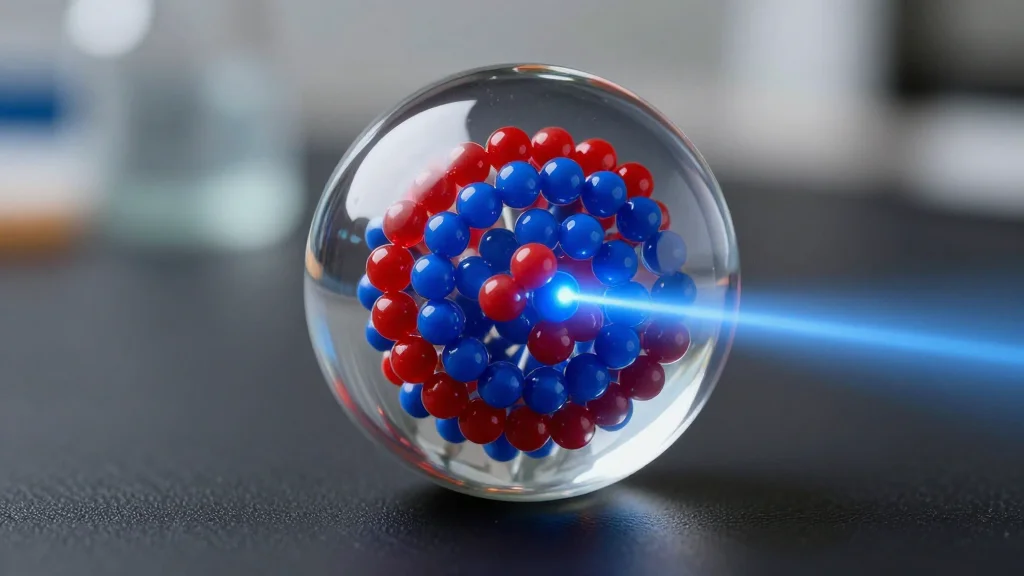
Quantum Shell Structure Reveals New Rule for Proton-Neutron Pairing Inside Nuclei
Why It Matters
The discovery reshapes our understanding of nuclear forces, impacting theoretical models of atomic nuclei and informing high‑energy physics and astrophysical simulations.
Key Takeaways
- •New quantum selection rule links shell structure to proton‑neutron short‑range correlations
- •Neutron addition to outer shell raises SRCs only ~10%, defying expectations
- •Proton addition in same shell lifts SRCs ~50%, surpassing count prediction
- •Experiment used 10.5 GeV electron beam at Jefferson Lab’s CEBAF in four‑day run
- •Nature publication validates rapid SRC measurement method, enabling broader nuclear physics studies
Pulse Analysis
Short‑range correlations (SRCs) have long been a puzzle in nuclear physics, describing fleeting, high‑momentum pairings of nucleons that influence everything from the internal quark dynamics of protons to the behavior of dense astrophysical objects. Traditional models linked SRC prevalence to overall neutron excess or nuclear mass, but inconsistencies in experimental data left a gap in our theoretical framework. By situating the new findings within this broader context, researchers underscore how a refined understanding of SRCs can improve predictions for neutron‑star interiors and inform the design of next‑generation particle accelerators.
The Jefferson Lab team leveraged the unique properties of "magic" and "doubly magic" nuclei—configurations where proton or neutron shells are completely filled—to isolate the effect of shell structure on SRC formation. Using a 10.5 GeV electron beam, they knocked out protons from calcium‑40, calcium‑48, and iron‑54 targets, measuring the resulting SRC rates with high‑precision spectrometers. The data revealed a stark contrast: adding eight neutrons to calcium‑40 produced only a modest 10% rise in SRCs, whereas adding six protons to calcium‑48 generated a 50% surge. This asymmetry points to a quantum selection rule where nucleons sharing the same shell couple far more efficiently than those in different shells, overturning earlier assumptions that mass or neutron excess alone dictate pairing strength.
Beyond its immediate scientific impact, the experiment demonstrates a rapid, cost‑effective methodology for probing SRCs, opening the door to systematic studies across a broader range of isotopes. The ability to quickly assess how shell configurations affect nucleon pairing will accelerate the refinement of nuclear interaction models, benefiting fields from nuclear energy to medical isotope production. As the collaboration prepares to analyze lighter nuclei and integrate complementary data from CEBAF’s large‑acceptance spectrometer, the new rule promises to become a cornerstone of next‑generation nuclear theory, guiding both experimental design and computational simulations.
Quantum shell structure reveals new rule for proton-neutron pairing inside nuclei
Comments
Want to join the conversation?
Loading comments...