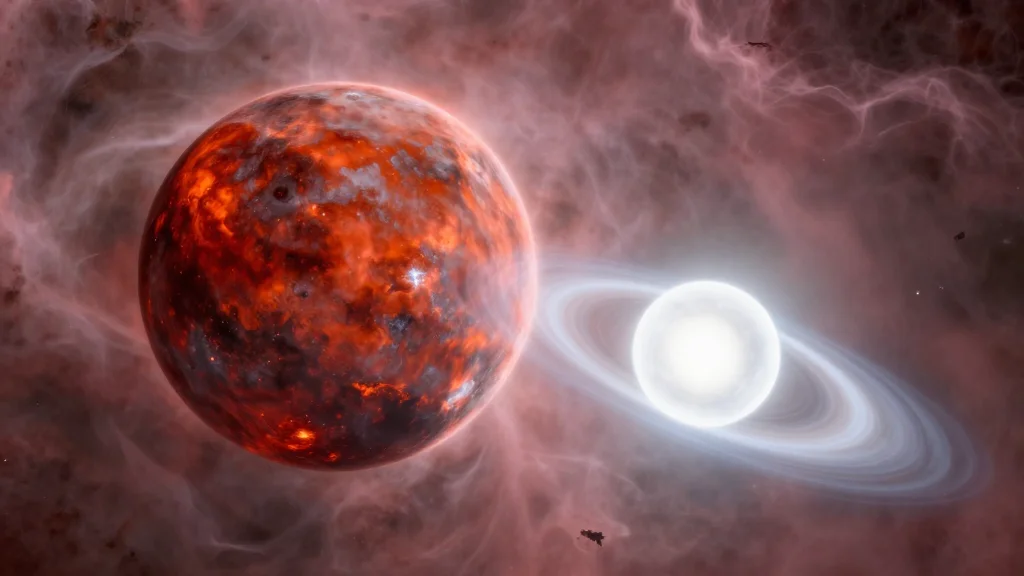
Why It Matters
Understanding R Aquarii’s interaction sheds light on how mass exchange drives explosive phenomena in binary stars, informing models of nova precursors and stellar evolution. Its proximity allows high‑resolution, multi‑wavelength observations that refine theories of accretion‑driven nebula formation.
Key Takeaways
- •R Aquarii is a symbiotic binary 44-year elliptical orbit.
- •Red giant pulsates every 390 days, feeding white dwarf.
- •Accretion disk outbursts create surrounding nebula visible in X‑ray.
- •At ~700 light‑years, it's the nearest symbiotic binary to Earth.
- •Combined X‑ray and optical imaging reveals twisted nebular structure.
Pulse Analysis
Symbiotic star systems—where a cool giant shares a close orbit with a compact white dwarf—are astrophysical laboratories for mass‑transfer physics. R Aquarii, situated about 700 light‑years from Earth, stands out because its 44‑year elliptical dance is well‑characterized and its giant’s 390‑day pulsation rhythmically supplies material. This proximity enables astronomers to resolve fine details of the binary’s gravitational interplay, offering a benchmark for comparing more distant, less accessible systems.
When the white dwarf siphons enough hydrogen from the giant, an accretion disk forms and eventually ignites a thermonuclear outburst. The resulting shock waves sculpt a complex nebula that glows across the spectrum, from X‑ray to optical wavelengths. Recent composite imaging, blending NASA’s X‑ray observatories with Hubble’s visible‑light data, reveals twisted filaments and shock fronts that map the flow of ejected material. These multi‑wavelength snapshots help researchers trace how accretion‑driven eruptions inject energy into surrounding space, influencing nebular chemistry and morphology.
Beyond its visual spectacle, R Aquarii informs broader questions about binary evolution and nova progenitors. By monitoring the timing and intensity of outbursts, scientists can calibrate models predicting when a white dwarf might approach the Chandrasekhar limit, a key step toward Type Ia supernovae. Future observations with next‑generation telescopes will probe the system’s magnetic fields and disk dynamics, sharpening our grasp of how mass transfer shapes stellar lifecycles and contributes to galactic enrichment.
R Aquarii’s strange, twisted relationship
Comments
Want to join the conversation?
Loading comments...