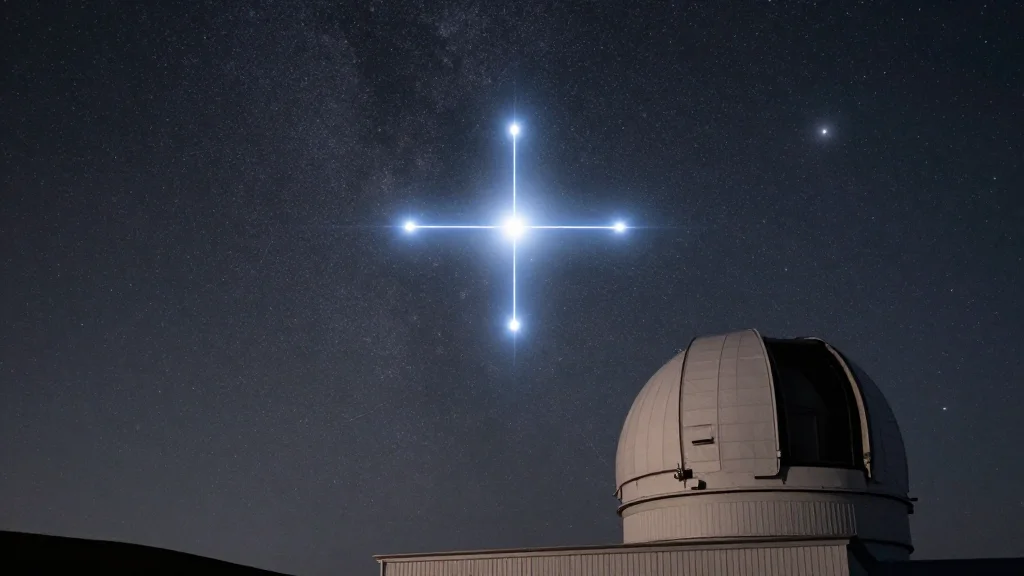
Rare Einstein Cross Lens Reveals Ancient Stars in Young Galaxy, Challenging Evolution Models

Why It Matters
The J1453g Einstein Cross provides a rare, high‑resolution glimpse into the stellar makeup of a galaxy when the universe was still in its formative stages. By showing that mature, Milky Way‑like stars existed far earlier than expected, the discovery forces astrophysicists to reconsider the speed and mechanisms of chemical enrichment and mass assembly. This has downstream effects on dark matter modeling, the interpretation of early‑universe observations, and the calibration of cosmological simulations that underpin much of modern astrophysics. Moreover, the study highlights gravitational lensing as a critical tool for probing the distant universe, reinforcing its role in upcoming large‑scale surveys. As more lenses are identified, the statistical power to test competing galaxy‑formation scenarios will increase, potentially leading to a paradigm shift in how we map the growth of structure across cosmic time.
Key Takeaways
- •Astronomers led by Quirino D'Amato (INAF) discovered Einstein Cross lens J1453g, 8 billion light‑years away.
- •The lens reveals an elliptical galaxy with mature, Milky Way‑like stars at a cosmic age <6 billion years.
- •Findings challenge prevailing models that predict primitive, metal‑poor stars in early galaxies.
- •Gravitational lensing enabled precise mass measurement, offering a new benchmark for high‑redshift studies.
- •Future observations with JWST and Rubin Observatory aim to locate more such lenses to refine galaxy‑formation theories.
Pulse Analysis
The J1453g discovery arrives at a crossroads for galaxy‑formation theory. For decades, simulations such as Illustris and EAGLE have suggested a gradual buildup of metals and stellar mass, driven by steady star formation and hierarchical mergers. An object that already hosts a chemically mature core at a redshift corresponding to a universe under six billion years old forces a re‑examination of those assumptions. One plausible interpretation is that certain environments—perhaps dense proto‑clusters or regions with early black‑hole feedback—can accelerate star formation and enrichment, compressing what would normally be a multi‑billion‑year process into a few hundred million years.
If subsequent surveys uncover a population of similar lenses, the community may need to adjust the sub‑grid physics in cosmological models, especially the treatment of early supernova feedback and gas inflows. This could also impact dark‑matter halo occupation models, as a higher stellar mass fraction at early times would imply different halo growth histories. The discovery underscores the importance of gravitational lensing not just as a curiosity but as a quantitative probe that can validate or falsify theoretical frameworks.
Looking ahead, the synergy between lensing studies and next‑generation telescopes promises a rapid expansion of the high‑redshift dataset. As the sample size grows, statistical analyses will either confirm J1453g as an outlier or reveal a hidden class of early, mature galaxies. Either outcome will refine our narrative of cosmic evolution, making the Einstein Cross a pivotal reference point for the next decade of extragalactic astronomy.
Rare Einstein Cross Lens Reveals Ancient Stars in Young Galaxy, Challenging Evolution Models
Comments
Want to join the conversation?
Loading comments...