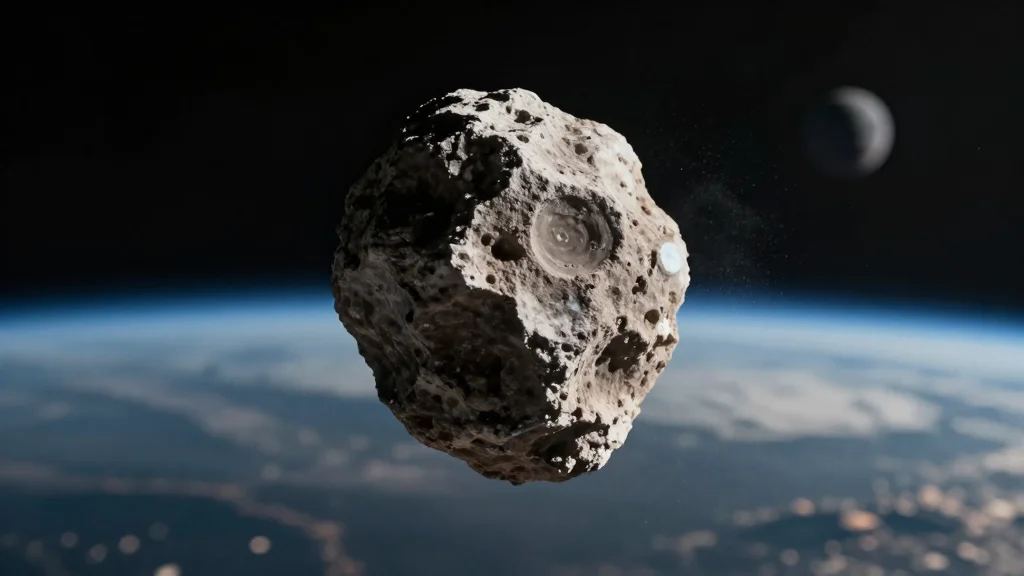
Rare Meteorite Provides Evidence of Giant Early Planet
Why It Matters
The discovery reveals that sizable protoplanets formed and were destroyed early in solar‑system history, implying a more chaotic accretion environment than previously thought. It forces a revision of models that assume all angrites originated from minor bodies, affecting theories of Earth’s building blocks.
Key Takeaways
- •NWA 12774 clinopyroxene formed under 17.5 kilobars pressure
- •Parent body size estimated at 1,000–1,800 km radius
- •Angrites previously thought to originate from small asteroids
- •Discovery suggests distinct planetary formation pathway
- •More undiscovered protoplanets may exist in meteorite collections
Pulse Analysis
The rarity of angrite meteorites—only 68 known among 80,000+ finds—has long made them a curiosity for planetary scientists. The Northwest Africa 12774 specimen stands out because its clinopyroxene crystals contain unusually high aluminum, a signature of formation under extreme pressure. By reconstructing those conditions, researchers concluded the parent body required pressures far beyond what a typical asteroid could sustain, pointing to a planetary embryo at least a thousand kilometers across. This breakthrough provides the first direct evidence that sizable protoplanets existed and were shattered in the solar system’s infancy.
Implications for early solar‑system models are profound. Traditional accretion theories assume a relatively orderly growth of planets from kilometer‑scale planetesimals, with occasional giant impacts. The NWA 12774 data suggests that large, differentiated bodies formed quickly and were subsequently destroyed, contributing diverse material to the nascent terrestrial planets. The distinct chemistry of the angrite parent body—low silica and high aluminum—implies a separate evolutionary track, potentially seeding Earth and Mars with exotic building blocks that differ from those of the main planetary cores.
Future research will likely revisit museum drawers and meteorite collections, applying high‑resolution spectroscopy and geobarometry to uncover more hidden protoplanets. As scientists refine pressure‑temperature models, the catalog of early planetary embryos may expand, offering new constraints for exoplanet formation studies. Understanding how these lost worlds broke apart can also inform models of debris disks around young stars, bridging solar‑system archaeology with broader astrophysical contexts.
Rare meteorite provides evidence of giant early planet
Comments
Want to join the conversation?
Loading comments...