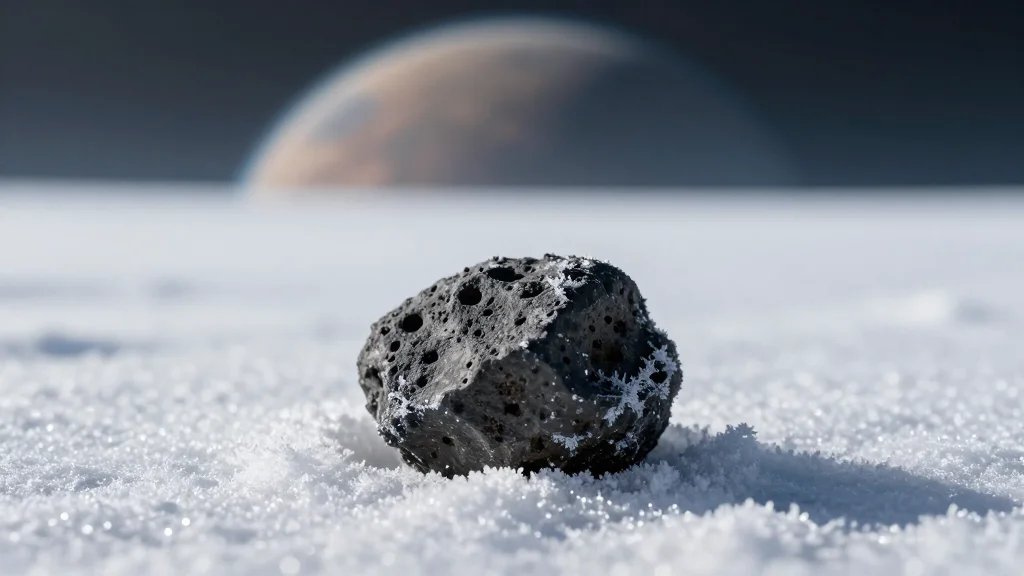
Rare Meteorite Provides Evidence of Giant Early Planet
Why It Matters
The discovery confirms that large planetary embryos existed and were destroyed, forcing a rethink of how Earth and its neighbors formed. It offers tangible data to refine models of early Solar System dynamics and planetary composition.
Key Takeaways
- •Antarctic meteorite shows isotopic ratios unlike any known chondrite
- •Tungsten‑molybdenum anomalies suggest material from a Mars‑sized body
- •Meteorite age of 4.56 billion years dates it to Solar System formation
- •Evidence supports theories of a missing early giant planet
- •Findings will recalibrate planetary formation simulations
Pulse Analysis
The rare meteorite, unearthed during a 2023 Antarctic expedition, has become a cornerstone for planetary scientists seeking clues about the Solar System’s formative years. Its mineralogy and isotopic composition differ markedly from typical chondritic meteorites, featuring elevated levels of siderophile elements such as tungsten and molybdenum. These signatures indicate the sample originated from a differentiated source that experienced core‑formation, a process only possible in a body large enough to generate sufficient heat—roughly the size of Mars. By dating the rock to 4.56 billion years, researchers have anchored the event to the epoch when planetary embryos were colliding and merging.
The implications extend beyond academic curiosity. Existing dynamical models have long hypothesized a "Planet V" or similar massive protoplanet that destabilized the inner Solar System, but direct evidence was missing. This meteorite provides the physical proof that such a planet existed and was likely shattered in a high‑energy impact, scattering debris that later coalesced into smaller bodies, including Earth. The data also refine estimates of the timing and frequency of giant impacts, informing theories about how Earth acquired its water and volatile inventory.
For the broader space‑industry and exploration community, the discovery underscores the value of meteorite recovery programs and advanced isotopic analysis. As private and governmental missions plan to return samples from asteroids and moons, the meteorite’s story illustrates how even a single fragment can rewrite planetary history. Future missions may target similar fragments or their parent bodies, leveraging the new isotopic benchmarks to map the early Solar System’s architecture with unprecedented precision.
Rare Meteorite Provides Evidence of Giant Early Planet
Comments
Want to join the conversation?
Loading comments...