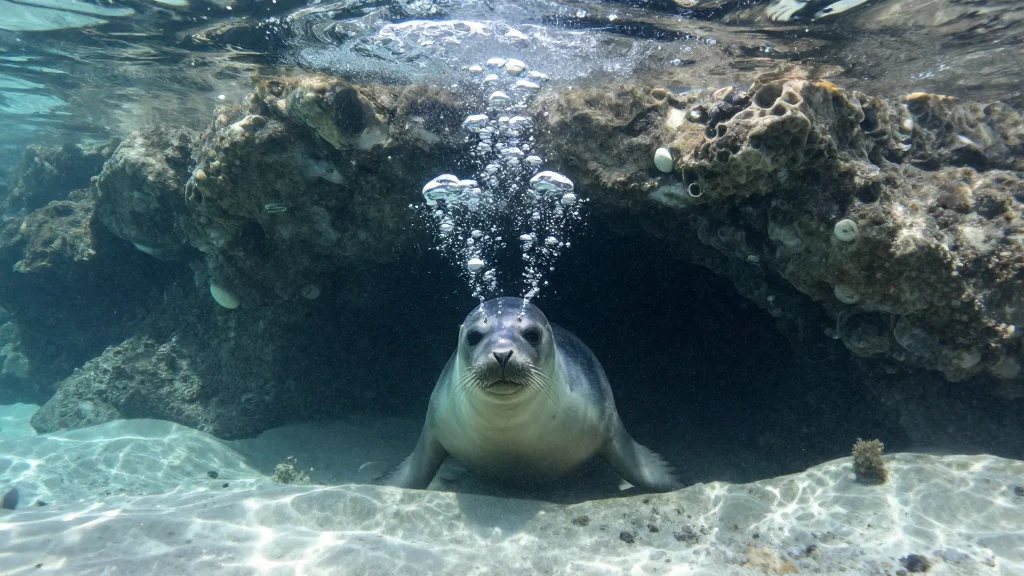
Rare Seals Spotted Snoozing in an Underwater ‘Bubble Cave’
Why It Matters
Bubble caves offer a low‑disturbance sanctuary, improving survival odds for the world’s rarest pinniped. Incorporating these micro‑habitats into conservation plans could reduce human‑seal conflicts during peak tourism.
Key Takeaways
- •Seals used bubble cave on 119 of 141 days monitored
- •Bubble caves accessed via underwater passages reduce human disturbance
- •Greece set 200‑m no‑entry zone around Formicula in 2024
- •Octopus Foundation deployed solar‑powered cameras for undisturbed monitoring
- •Protecting bubble caves could improve seal resting habitats during tourism season
Pulse Analysis
The identification of underwater "bubble caves" adds a new dimension to monk seal conservation. While traditional protection efforts focus on large coastal caves and beach haul‑outs, these compact, air‑filled domes provide seals with a quiet refuge reachable only through narrow submerged tunnels. The recent study, published in Oryx, used a solar‑powered, autonomous camera system to capture seal behavior without intrusion, revealing that the seals preferred the bubble cave for resting on 119 of 141 monitoring days—far more often than the main cave. This behavior underscores the seals' sensitivity to human presence and the value of micro‑habitats that are naturally shielded from disturbance.
From a policy perspective, the findings dovetail with Greece’s recent marine protection measures. In 2024, the government established a 200‑meter restricted‑access zone around Formicula and approved two extensive marine protected areas in the Ionian and southern Aegean seas. These actions aim to curb tourist‑driven disruptions that force seals into suboptimal habitats. By formally recognizing bubble caves as critical resting sites, regulators can expand protection boundaries to include these underwater sanctuaries, ensuring that conservation zoning reflects the full spectrum of seal habitat use.
Technologically, the study showcases how low‑impact monitoring can yield actionable insights. The Octopus Foundation’s solar‑powered camera array, housed in a watertight case, recorded high‑resolution images at regular intervals, allowing researchers to assess seal occupancy without altering natural behavior. Such non‑invasive tools are essential for studying vulnerable species where direct observation could cause stress. As marine tourism grows, integrating similar monitoring systems across the Mediterranean could help map hidden refuges, guide adaptive management, and ultimately support the recovery of the world’s rarest pinniped.
Rare seals spotted snoozing in an underwater ‘bubble cave’
Comments
Want to join the conversation?
Loading comments...