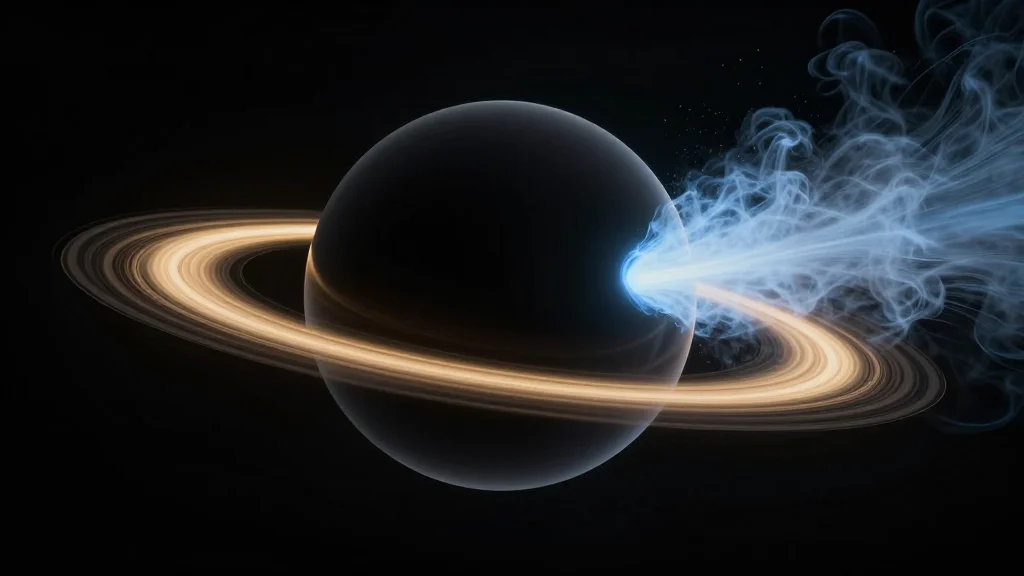
Record Ultraviolet Quasar Wind Reaches 30% Light Speed Near Supermassive Black Hole
Why It Matters
Such extreme outflows carry enough energy to regulate star formation and drive galaxy‑scale feedback, a key ingredient in cosmological models. Demonstrating that undergraduates can lead cutting‑edge discoveries also expands the talent pipeline for astrophysics.
Key Takeaways
- •UV quasar wind reaches 0.3c, fastest observed at these wavelengths
- •Quasar J2318 hosts 1.7 billion‑solar‑mass black hole
- •Discovery enabled by SDSS data and Gemini North telescope
- •Findings inform galaxy‑feedback models in cosmological simulations
- •Undergraduate involvement showcases SDSS FAST program’s research impact
Pulse Analysis
Quasar winds are a fundamental mechanism by which active galactic nuclei influence their surroundings. While X‑ray observations have revealed ultra‑fast outflows exceeding 0.5c, ultraviolet studies have lagged behind due to limited spectral resolution. The detection of a 0.3c UV wind in J2318 bridges this gap, showing that photon‑driven acceleration can achieve relativistic speeds without fully ionizing the gas, preserving observable carbon and silicon signatures. This nuance refines our understanding of how radiation pressure shapes the multi‑phase structure of quasar-driven outflows.
The breakthrough emerged from a synergy of large‑scale surveys and targeted follow‑up. The Sloan Digital Sky Survey’s Time‑Domain Spectroscopic Survey and Black Hole Mapper provided high‑cadence spectra that flagged J2318 as anomalous, while the eight‑meter Gemini North telescope delivered the confirming observations. Crucially, the project integrated graduate and undergraduate researchers, illustrating how open data platforms and collaborative programs like SDSS FAST can democratize discovery. Such inclusive models accelerate talent development and expand the pool of scientists capable of handling complex data pipelines.
From a cosmological perspective, extreme outflows act as a feedback conduit, injecting kinetic energy into the host galaxy’s interstellar medium. Simulations have long relied on parametrized wind prescriptions to reproduce observed galaxy mass functions, yet empirical constraints remain sparse. The J2318 wind offers a concrete benchmark for calibrating these models, especially regarding the coupling efficiency of radiation pressure in the UV regime. Ongoing searches for comparable or faster UV outflows will test whether J2318 is an outlier or the tip of a broader population, potentially reshaping theories of galaxy evolution.
Record ultraviolet quasar wind reaches 30% light speed near supermassive black hole
Comments
Want to join the conversation?
Loading comments...