Recyclable Material Unlocks New Era for 3D Printing
Why It Matters
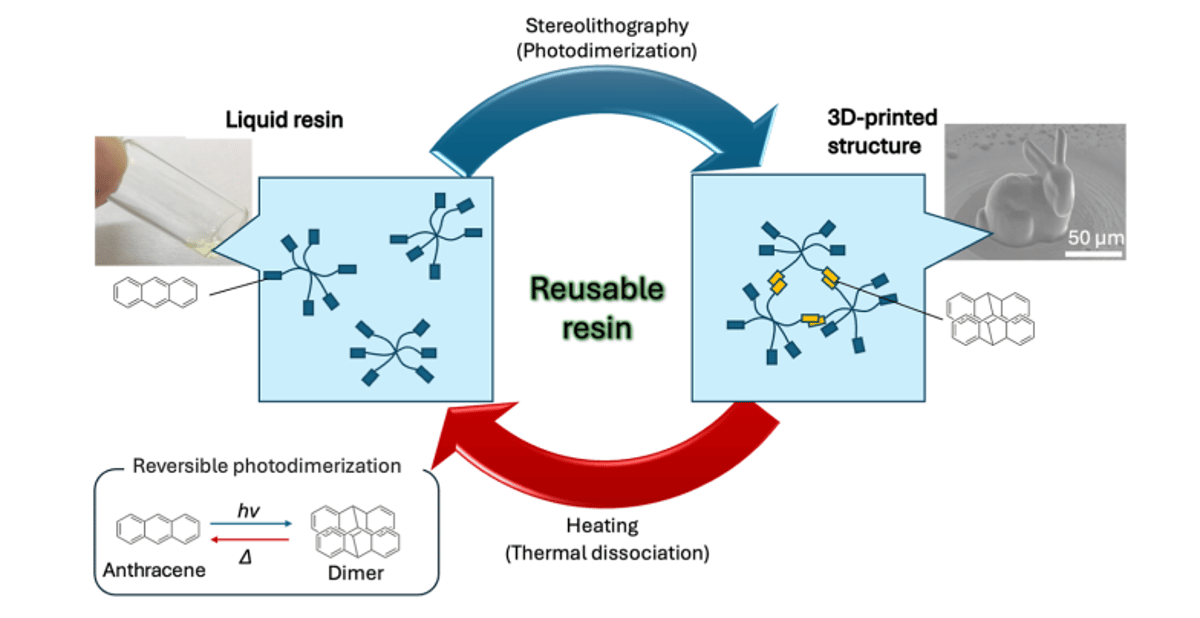
The resin offers a practical path to close the loop on 3D‑printing waste, reducing reliance on disposable photopolymers and lowering material costs for high‑precision manufacturing. Its compatibility with existing stereolithography platforms accelerates adoption across industrial and research settings.
Key Takeaways
- •Anthracene resin prints, melts, reprints over ten cycles
- •No photoinitiators or additives needed for recycling
- •Achieves 0.61 µm line width, matching conventional resins
- •Modulus rises from 2.43 GPa to 5.39 GPa after ten cycles
- •Works with two‑photon and single‑photon stereolithography
Pulse Analysis
Additive manufacturing has long struggled with the single‑use nature of photocurable resins, creating a growing waste stream and limiting cost efficiency. The new anthracene‑based resin sidesteps this problem by embedding reversibility directly into its molecular architecture. Through a photodimerization reaction, blue‑light exposure creates a cross‑linked network that can be undone with modest heat, eliminating the need for post‑print purification or external recycling agents. This step‑growth approach contrasts with traditional chain‑growth chemistries, offering a cleaner, more controllable pathway for material reuse.
Technical performance validates the concept beyond laboratory curiosity. Using two‑photon lithography, the team produced features as fine as 0.61 µm, a resolution on par with industry‑standard resins that are notoriously difficult to recycle. Mechanical testing revealed a predictable stiffening trend, with the reduced elastic modulus climbing from 2.43 GPa initially to 5.39 GPa after ten cycles, while viscosity drift remained minimal. Overcoming challenges such as localized polymerization and layer adhesion required innovations like perfluoroalkoxy film substrates, demonstrating the material’s readiness for integration with existing microstereolithography equipment.
The broader impact extends to the emerging ecosystem of recyclable photopolymers. Parallel efforts at Zhejiang University and the University of Birmingham have introduced thermally reversible and bio‑based resins, respectively, each tackling sustainability from different angles. Yokohama’s anthracene system distinguishes itself by requiring no external catalysts or feedstock changes, simplifying the recycling loop. As manufacturers seek to scale sustainable production, this resin could enable larger‑format DLP printers and industrial‑grade workflows, reducing material waste and operational costs while maintaining the high precision demanded by sectors such as medical devices and micro‑electronics. The convergence of recyclability and performance marks a pivotal step toward a circular economy in 3D printing.
Recyclable Material Unlocks New Era for 3D Printing
Comments
Want to join the conversation?
Loading comments...