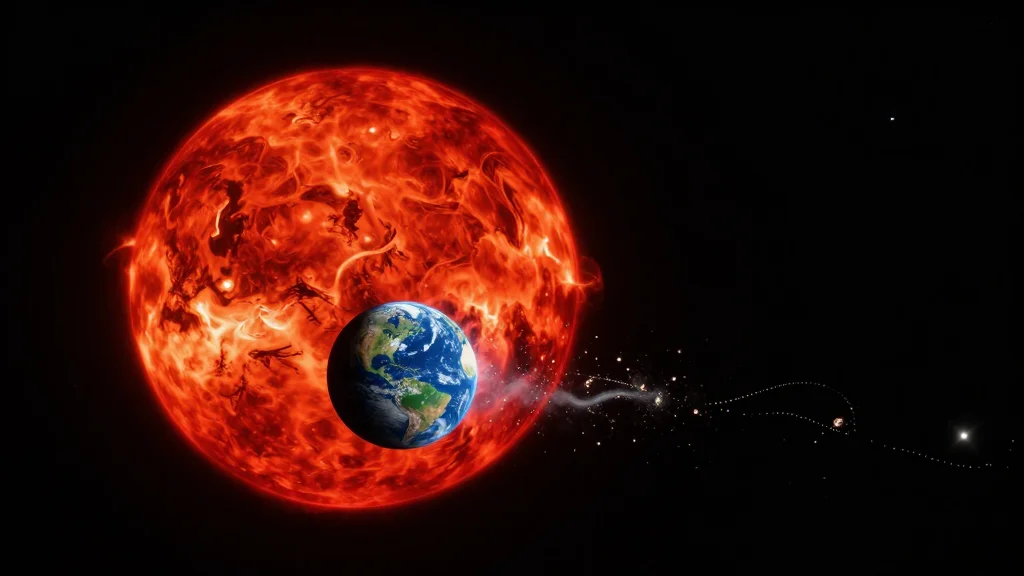
Red Dwarf Stars Detected “Eating” Earth-Like Planets
Why It Matters
The findings undermine the long‑held belief that red dwarfs could host stable, life‑supporting planets, prompting a reassessment of exoplanet habitability models and future mission target lists.
Key Takeaways
- •Red dwarfs observed stripping atmospheres from nearby rocky planets
- •Infrared telescopes captured debris trails indicating planetary disintegration
- •Habitability zones around red dwarfs may be less stable than thought
- •Study expands understanding of star‑planet tidal interactions
Pulse Analysis
The detection of planetary consumption by red dwarf stars represents a watershed moment in exoplanet science. While red dwarfs account for roughly 70% of stars in the Milky Way, their volatile magnetic activity and close‑in habitable zones have long been debated. By leveraging the high‑resolution spectroscopic capabilities of the James Webb Space Telescope, researchers identified characteristic absorption lines of silicate vapor and metal oxides, signatures that only arise when a rocky planet is being torn apart. Complementary observations from the Atacama Large Millimeter/submillimeter Array (ALMA) traced the resulting dust clouds, confirming that the material is not merely atmospheric loss but full planetary disintegration.
These observations carry profound implications for the search for life beyond Earth. Traditional models placed the "Goldilocks" zone of red dwarfs at fractions of an astronomical unit, where tidal forces and stellar flares could erode atmospheres over billions of years. The new evidence suggests that even planets initially within this zone may face catastrophic destruction on much shorter timescales, potentially reducing the number of viable targets for missions like the Nancy Grace Roman Space Telescope and the upcoming HabEx concept. Consequently, astrobiologists are revisiting criteria for biosignature detection, emphasizing the need to prioritize stars with calmer activity profiles.
Beyond habitability, the study enriches our broader understanding of star‑planet dynamics. The measured mass‑loss rates provide empirical data to refine theoretical models of tidal disruption and orbital decay, phenomena that also influence the evolution of planetary systems around more massive stars. As astronomers continue to monitor these red dwarf systems, the growing dataset will help calibrate simulations of planetary system lifecycles, informing everything from planet formation theories to the long‑term stability of our own solar neighborhood. The convergence of observational breakthroughs and refined modeling heralds a new era of precision exoplanetology.
Red Dwarf Stars Detected “Eating” Earth-Like Planets
Comments
Want to join the conversation?
Loading comments...