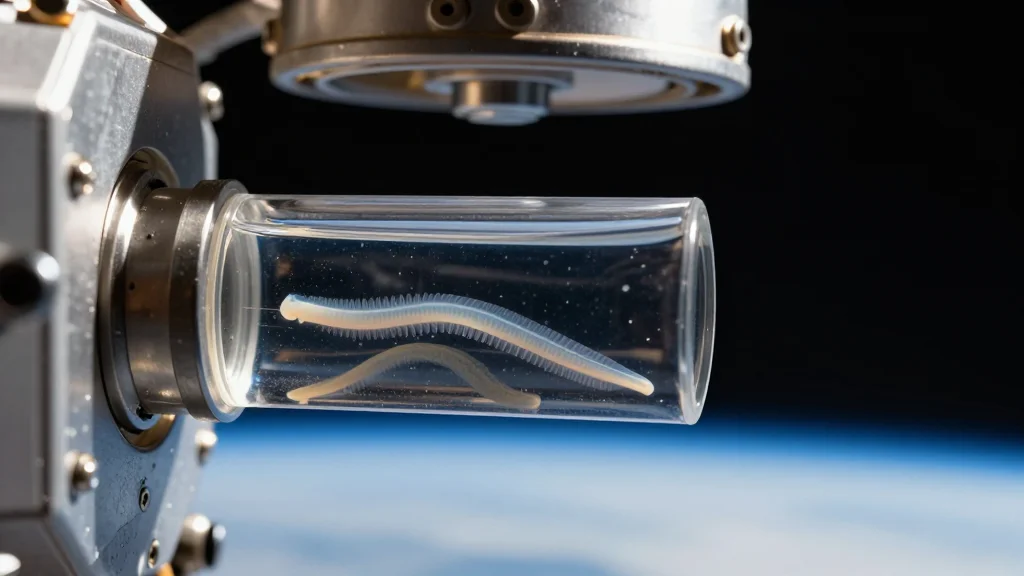
Regarding Those Worms Outside The ISS
Companies Mentioned
Why It Matters
The experiment provides low‑cost, high‑impact data on biological responses to space stressors, directly supporting countermeasure development for long‑duration human missions.
Key Takeaways
- •Petri Pod weighs ~3 kg and contains 12 independent chambers
- •Experiment will expose C. elegans to vacuum, radiation for 15 weeks
- •Data could inform countermeasures for bone loss and radiation risks in astronauts
- •UK government funding highlights national commitment to space biology research
- •Robotic arm will attach pod externally after initial ISS integration
Pulse Analysis
C. elegans has been a workhorse for genetics and developmental biology for decades, and its simplicity makes it ideal for spaceflight studies. The worm’s transparent body, short lifecycle, and well‑mapped genome allow scientists to monitor cellular stress, DNA damage and metabolic shifts in real time. By placing these organisms in the harsh environment of low‑Earth orbit—exposed to vacuum, temperature extremes and heightened radiation—researchers can capture biological responses that are otherwise impossible to replicate on Earth.
The Fluorescent Deep Space Petri‑Pods (FDSPP) mission leverages a compact, autonomous laboratory built by the University of Leicester. Each of the 12 chambers maintains its own micro‑environment, with independent temperature and pressure controls, while an agar substrate supplies nutrients. Over a 15‑week external stint, high‑resolution fluorescent imaging will document worm morphology and gene‑expression changes, feeding a data stream that can be correlated with radiation dose measurements. These insights are expected to translate into human‑focused countermeasures, such as targeted pharmaceuticals or habitat design tweaks that mitigate bone density loss, muscle atrophy and radiation‑induced DNA damage during lunar trips or Mars voyages.
Beyond the scientific payoff, the project underscores the United Kingdom’s growing role in commercial space research. Government backing signals confidence in small‑scale, high‑return experiments that can be rapidly deployed on existing ISS infrastructure. Success could attract private investment into bio‑space platforms, stimulate cross‑border collaborations, and accelerate the development of life‑support technologies essential for a sustainable lunar base. As agencies worldwide race to return to the Moon, data from these humble worms may become a cornerstone of the health‑preservation toolkit for the next generation of explorers.
Regarding Those Worms Outside The ISS
Comments
Want to join the conversation?
Loading comments...