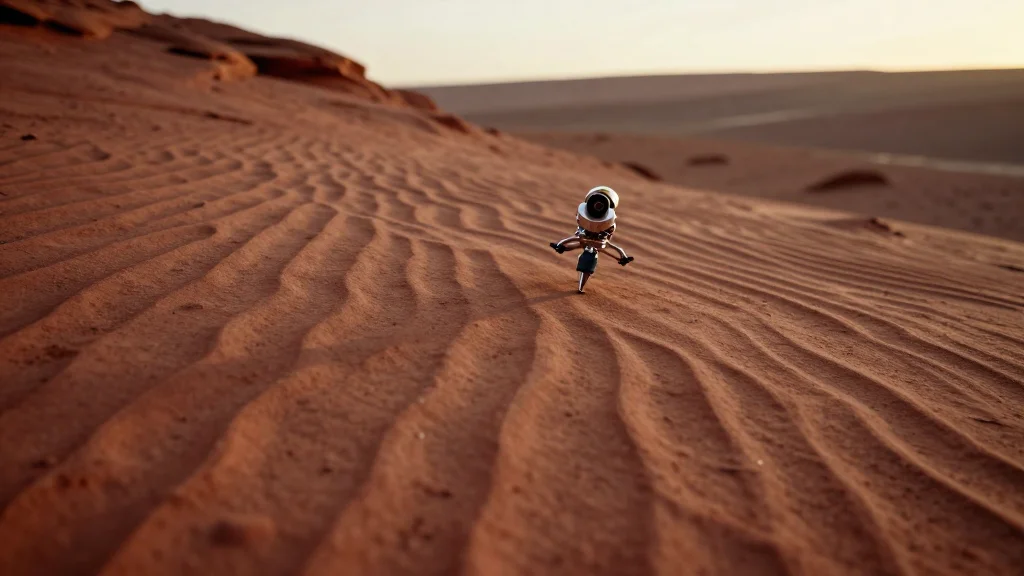
Relics of an Ancient Sandstorm on Mars Point to Earth-Like Winds
Why It Matters
If Mars once had near‑Earth atmospheric pressure, liquid water could have been stable, reshaping habitability models and guiding future exploration. The new proxy could finally quantify that ancient pressure, a long‑standing gap in planetary science.
Key Takeaways
- •Fossil ripples reveal ancient Mars sandstorm.
- •Ripples suggest atmosphere once Earth‑like pressure.
- •Storm likely lasted hours, moving waist‑high sand.
- •Provides new proxy for paleo‑atmospheric pressure.
- •Debate persists on ripple formation mechanisms.
Pulse Analysis
The Curiosity rover’s latest find adds a vivid chapter to the story of Mars’ atmospheric evolution. While today the Red Planet endures thin, dust‑laden breezes, the fossilized supercritical climbing ripples—steep, stacked sand formations—record a time when wind could loft sand as easily as on Earth. By analyzing ripple spacing and morphology, scientists infer that the ancient Martian air density approached levels needed for robust aeolian transport, hinting at a period when the planet could retain liquid water on its surface.
Beyond the visual intrigue, these ripples serve as a potential paleo‑pressure proxy, a tool long sought by planetary geologists. Quantifying atmospheric pressure 3.6 billion years ago would tighten models of how Mars transitioned from a warm, wet world to its current cold, arid state. A thicker early atmosphere would have not only facilitated stronger winds but also enhanced greenhouse warming, possibly extending the lifespan of surface water reservoirs. This insight dovetails with recent isotopic studies suggesting substantial atmospheric loss, offering a more concrete benchmark for the magnitude of that loss.
The interpretation is not without contention. Some experts argue that Mars’ lower gravity, rather than higher pressure, could produce similar ripple geometries, complicating the proxy’s calibration. Ongoing laboratory experiments and high‑resolution modeling aim to disentangle these variables. As missions like Perseverance and future sample‑return endeavors target ancient terrains, the ripple evidence underscores the importance of integrating sedimentology with atmospheric science to unravel Mars’ climatic past and assess its habitability potential.
Relics of an ancient sandstorm on Mars point to Earth-like winds
Comments
Want to join the conversation?
Loading comments...