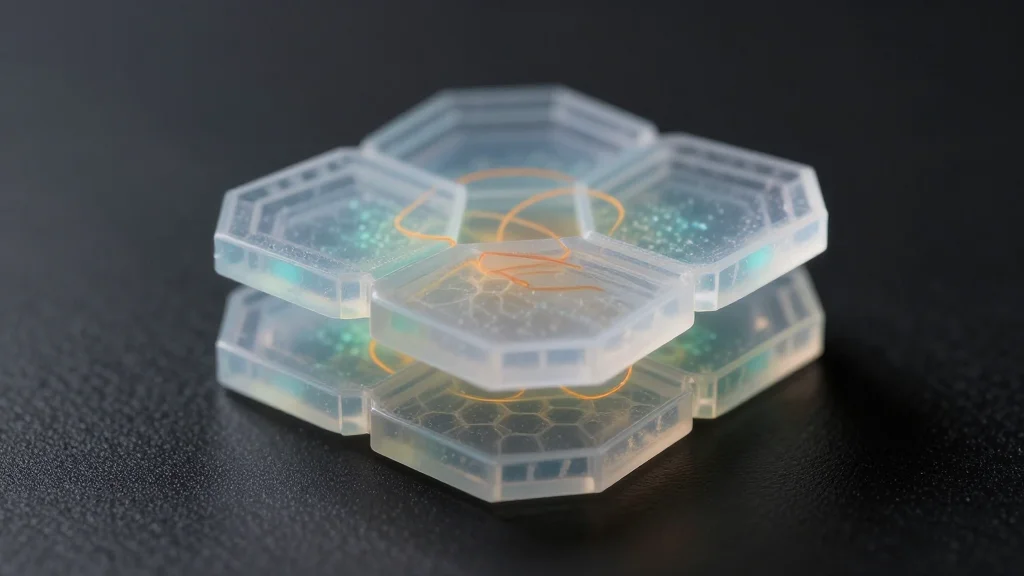
Research Uncovers Novel Electronic Properties in Quantum Material
Why It Matters
The discovery provides a scalable platform for exploring intertwined superconducting and topological phenomena, accelerating the path toward practical quantum hardware and new condensed‑matter insights.
Key Takeaways
- •Rhombohedral graphene shows surface-localized electrons driving superconductivity.
- •Dual-surface electron/hole pairing yields quantum anomalous Hall effect.
- •Findings could enable Majorana zero modes for fault‑tolerant quantum computers.
- •Naturally occurring dual-layer charge geometry simplifies quantum device fabrication.
- •International team combined experimental and theoretical expertise to map new topological phases.
Pulse Analysis
Rhombohedral graphene, a stacked variant of the celebrated two‑dimensional material, has emerged as a fertile playground for quantum‑material research. Unlike the more common Bernal‑stacked graphene, its chiral staircase arrangement forces charge carriers onto the top and bottom atomic layers, leaving the bulk essentially inert. This surface confinement amplifies electron‑electron interactions, making the system exquisitely sensitive to subtle many‑body effects. The recent Nature Physics paper leverages these intrinsic properties, demonstrating that the material can host superconductivity without the need for elaborate gating or heterostructure fabrication, a breakthrough for scalable quantum platforms.
The team’s measurements reveal that superconductivity originates from a cooperative dance between electrons on one surface and hole‑like carriers on the opposite side. This dual‑surface pairing not only generates a zero‑resistance state but also coexists with a quantum anomalous Hall effect, where edge currents flow without dissipation. Such a combination is rare; it hints at the possible emergence of Majorana zero modes—quasiparticles that are their own antiparticles and are immune to local noise. If realized, these modes could underpin topological qubits that dramatically reduce error rates in quantum processors, a long‑sought goal for both academia and industry.
Beyond fundamental physics, the discovery carries practical implications. The natural occurrence of a vertically separated charge bilayer eliminates the need for artificial superlattices, simplifying device architecture and potentially lowering manufacturing costs. As quantum‑technology firms race to integrate robust qubits, a material that simultaneously offers superconductivity, topological protection, and manufacturability could become a cornerstone of next‑generation quantum sensors, interconnects, and processors. Ongoing collaborations aim to fine‑tune the carrier density and explore heterostructure hybrids, positioning rhombohedral graphene as a versatile platform for both experimental exploration and commercial quantum‑hardware development.
Research uncovers novel electronic properties in quantum material
Comments
Want to join the conversation?
Loading comments...