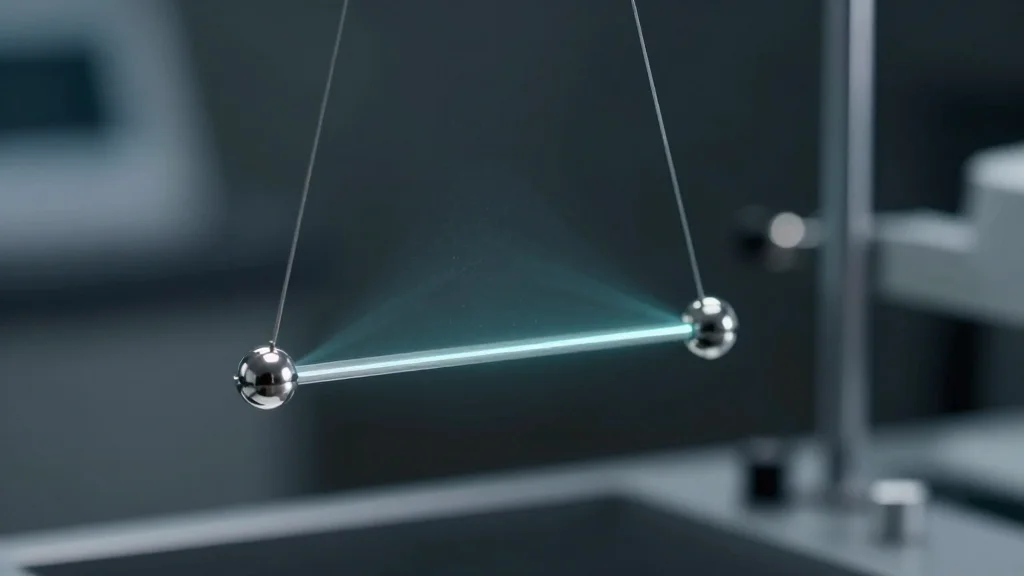
Researchers Adapt Torsion Balance Experiments to Detect Dark Matter
Why It Matters
The adaptation leverages existing, inexpensive equipment to probe dark‑matter parameter space previously inaccessible, accelerating discovery potential and diversifying experimental strategies across the field.
Key Takeaways
- •Torsion balances now achieve force sensitivity near 10‑21 N
- •Cryogenic and magnetic shielding reduce thermal noise dramatically
- •First IPMU data constrain axion‑like particle couplings
- •Method offers low‑cost, modular dark‑matter search platform
- •Results complement microwave cavity and atom‑interferometer experiments
Pulse Analysis
Torsion‑balance experiments have a storied legacy in fundamental physics, from Cavendish’s measurement of Newton’s constant to modern tests of the equivalence principle. Their core strength lies in detecting minuscule torques on a suspended test mass, a capability that researchers at the Institute for Particle‑Matter Universe (IPMU) have now redirected toward dark‑matter detection. By operating the balances at cryogenic temperatures and surrounding them with multi‑layer magnetic shielding, the team suppresses thermal and electromagnetic noise, allowing the instrument to register forces as faint as 10‑21 newtons—levels comparable to those sought by specialized resonant‑cavity searches.
The adapted setup targets ultra‑light dark‑matter candidates, particularly axion‑like particles that would induce oscillatory forces on the balance’s test masses. In initial runs, the IPMU team recorded no excess signal, but the resulting exclusion limits on the coupling strength between dark matter and ordinary matter already rival those from larger, more expensive facilities. This achievement underscores how modest, well‑engineered instruments can explore previously uncharted regions of the dark‑matter parameter space, offering a complementary approach to traditional detectors such as liquid‑xenon time‑projection chambers or microwave cavities.
Looking ahead, the modular nature of torsion‑balance platforms promises rapid scaling: multiple units can operate in parallel, each tuned to different frequency bands to scan a broader swath of candidate masses. Collaboration with other institutions could create a global network of synchronized balances, enhancing sensitivity through cross‑correlation techniques. If dark matter interacts via the forces these balances can detect, the method could deliver the first direct evidence, reshaping both particle physics and cosmology.
Researchers Adapt Torsion Balance Experiments to Detect Dark Matter
Comments
Want to join the conversation?
Loading comments...