Researchers Demonstrate Megawatt-Class Ga₂0₃ Module
Why It Matters
The breakthrough lifts ultra‑wide‑bandgap power electronics from kilowatt to megawatt scales, opening high‑efficiency pulsed‑power solutions for grids, medical systems and fusion reactors. It demonstrates a scalable path for commercializing Ga₂O₃ devices that can handle extreme voltage, current and temperature demands.
Key Takeaways
- •Megawatt Ga2O3 module switches 1000 V/1000 A continuously
- •Junction-side cooling with high‑permittivity layer reduces thermal resistance
- •Device achieves 23 ns switching, near‑zero reverse recovery
- •Demonstrated at 250 °C junction temperature, 1 kHz pulse rate
- •Enables pulsed power for grid, healthcare, fusion applications
Pulse Analysis
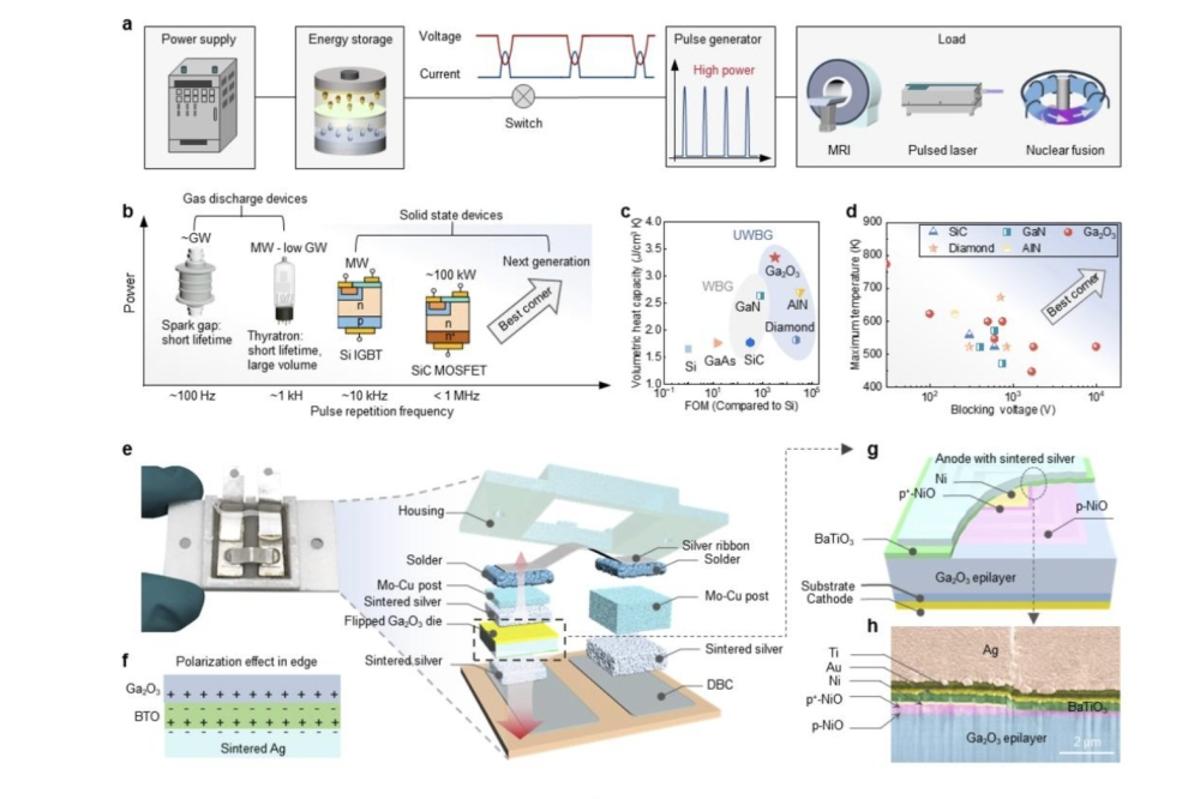
Ultra‑wide‑bandgap (UWBG) semiconductors have long promised performance beyond silicon and conventional wide‑bandgap materials, but practical power levels have stalled around a few kilowatts. Gallium oxide (Ga₂O₃) stands out for its exceptionally high breakdown field and thermal stability, yet material uniformity and packaging constraints have kept it from high‑power markets. The new megawatt‑class module demonstrates that a co‑optimised device‑package strategy can finally translate Ga₂O₃’s theoretical advantages into real‑world capability, shifting the performance envelope by more than two orders of magnitude.
The research team’s key innovation lies in a junction‑side cooling architecture that integrates a high‑permittivity interface layer. This design redistributes electric fields, raising breakdown voltage while dramatically lowering thermal resistance, allowing the silicon‑level device to operate at junction temperatures exceeding 250 °C. Coupled with ultra‑fast 23‑nanosecond switching and near‑zero reverse recovery, the six‑die module sustains 1 kHz pulsed operation at 1 MW, a milestone that validates Ga₂O₃ for demanding pulsed‑power applications where microsecond‑scale voltage and current spikes are routine.
The implications for industry are profound. Grid‑scale converters, high‑power medical imaging, and emerging fusion‑reactor drive systems all require compact, efficient, and thermally robust power electronics. A megawatt‑class Ga₂O₃ solution could reduce system size, improve efficiency, and lower cooling infrastructure costs compared with silicon carbide or silicon‑based alternatives. As the technology matures, manufacturers will likely pursue modular scaling and integration with existing power‑train architectures, accelerating the transition toward next‑generation energy‑conversion platforms. The breakthrough also signals a broader shift toward device‑package co‑design as a critical pathway for unlocking the full potential of UWBG materials.
Researchers demonstrate megawatt-class Ga₂0₃ module
Comments
Want to join the conversation?
Loading comments...