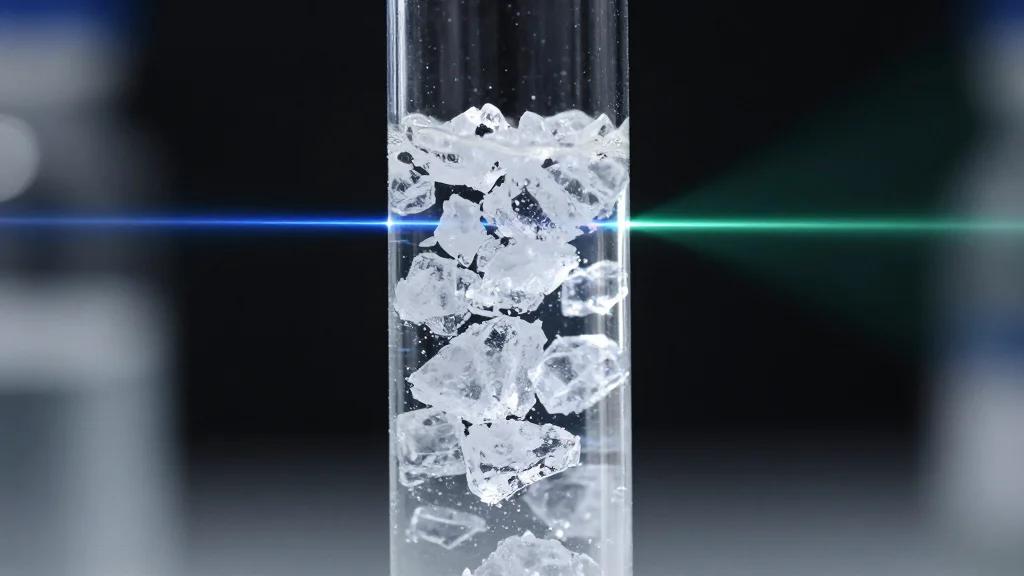
Researchers Pinpoint Liquid‑Liquid Critical Point of Water at 210 K, 1000 Bar

Why It Matters
Understanding water’s liquid‑liquid critical point resolves a fundamental paradox in physical chemistry: why water behaves so differently from other simple liquids when supercooled. A confirmed LLCP would validate the two‑state model that underpins many climate‑prediction algorithms, potentially improving forecasts of extreme weather events that depend on supercooled cloud droplets. In biology, the ability to keep water liquid at low temperatures without crystallization could revolutionize cryopreservation, extending the viable storage time for organs, vaccines, and cellular therapies. Beyond applied fields, the methodological breakthrough—precision melting of amorphous ice followed by ultrafast x‑ray probing—provides a template for exploring other substances that exhibit hidden critical phenomena. Researchers studying metallic glasses, silicon, or even exotic planetary ices may adopt similar techniques, expanding the frontier of high‑pressure, low‑temperature physics.
Key Takeaways
- •Anders Nilsson (Stockholm University) and Kyung Hwan Kim (Pohang University) report evidence of water’s LLCP at ~210 K, 1000 bar.
- •Experiment uses infrared laser heating of amorphous ice and x‑ray free‑electron laser scattering.
- •Findings align with long‑standing simulations predicting a high‑density/low‑density liquid transition.
- •Confirmation of LLCP could improve climate models, cryopreservation, and materials design.
- •Methodology offers a new route to study metastable phases in other substances.
Pulse Analysis
The discovery of water’s liquid‑liquid critical point marks a watershed for condensed‑matter physics, finally delivering experimental validation for a hypothesis that has guided theory for decades. Historically, the two‑state model of water emerged from computational work in the 1990s, but the inability to access the no‑man’s‑land region left the field divided. By leveraging the unique capabilities of free‑electron lasers—intense, femtosecond x‑ray pulses—the Nilsson‑Kim team overcame the kinetic barriers that have thwarted prior attempts. This technical leap underscores a broader trend: the convergence of ultrafast spectroscopy and high‑pressure physics to interrogate fleeting, metastable states.
From a market perspective, the implications extend beyond academic curiosity. Companies developing next‑generation climate‑modeling software and high‑precision cryogenic equipment are likely to integrate the refined water phase data into their algorithms and hardware designs. Moreover, the experimental platform itself could become a service offering for institutions lacking in‑house free‑electron‑laser access, spawning a niche ecosystem of collaborative research facilities.
Looking ahead, the real test will be reproducibility. Independent groups must confirm the critical temperature and pressure using alternative probes—perhaps neutron scattering or Raman spectroscopy—to cement the LLCP’s place in the water phase diagram. If the result holds, textbooks will be rewritten, and a new class of theoretical models will emerge, potentially unlocking deeper insights into other anomalous liquids that share water’s hydrogen‑bond network.
Researchers Pinpoint Liquid‑Liquid Critical Point of Water at 210 K, 1000 bar
Comments
Want to join the conversation?
Loading comments...