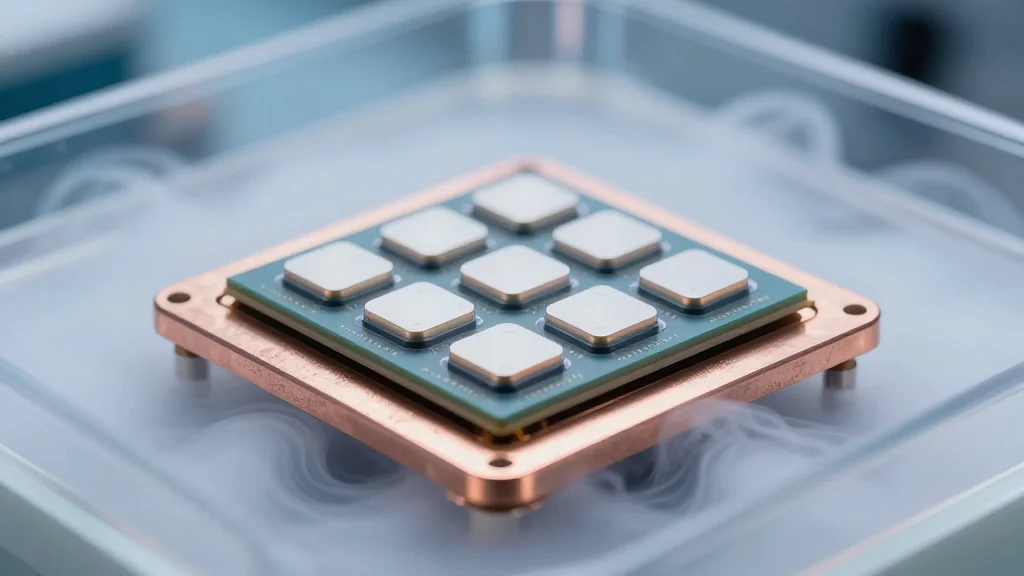
Rigetti Simulates Plasma Wave Dispersion on Superconducting Ankaa-3 Processor Using Specialized Error Mitigation
Companies Mentioned
Why It Matters
The work proves that near‑term quantum hardware can tackle complex plasma dynamics, opening new avenues for defense, energy, and materials research where classical simulations struggle.
Key Takeaways
- •Rigetti ran a 9‑qubit plasma simulation on 84‑qubit Ankaa‑3.
- •Dual error‑mitigation cut phase and gate noise, revealing clean wave signatures.
- •Simulation mapped dispersion across free space, density jump, and inhomogeneous plasma.
- •Collaboration includes Lawrence Livermore Lab and University of Colorado Boulder.
- •Results published in Physical Review Applied, showing quantum advantage potential.
Pulse Analysis
Plasma physics sits at the intersection of high‑energy research and computational limits. Classical supercomputers falter when particle interactions become strongly quantum, such as in dense or non‑equilibrium plasmas relevant to inertial confinement fusion and space weather forecasting. Quantum simulation offers a route to capture these effects directly, but hardware noise has traditionally obscured meaningful results. Rigetti’s recent experiment showcases how a modest nine‑qubit sub‑register can faithfully reproduce wave‑packet dynamics when paired with sophisticated error‑mitigation techniques.
The Ankaa‑3 processor’s transmon lattice was programmed to encode plasma density profiles as tunable microwave pulses, effectively turning the quantum chip into a spin‑model analog of the plasma. Randomized compilation transformed coherent gate errors into stochastic Pauli noise, while a linear‑regression model, trained on benchmark circuits, quantified and corrected amplitude decay across couplings. This dual‑layer approach reduced error margins enough to distinguish logical from mitigated outcomes, allowing researchers to map dispersion and reflection across three distinct plasma scenarios. The methodology sidesteps the need for deep, fault‑tolerant circuits, making it viable on today’s noisy intermediate‑scale quantum (NISQ) devices.
Beyond the academic breakthrough, the demonstration has tangible industry implications. Defense agencies and energy firms that rely on accurate plasma modeling can leverage quantum‑enhanced simulations to accelerate design cycles for weapons, reactors, and satellite shielding. Moreover, the collaborative framework—linking a quantum startup with national labs and academia—sets a precedent for future co‑development of domain‑specific quantum applications. As error‑mitigation protocols mature, scaling to larger qubit arrays could unlock predictive capabilities that outpace classical methods, positioning quantum computing as a strategic asset in high‑stakes scientific domains.
Rigetti Simulates Plasma Wave Dispersion on Superconducting Ankaa-3 Processor Using Specialized Error Mitigation
Comments
Want to join the conversation?
Loading comments...