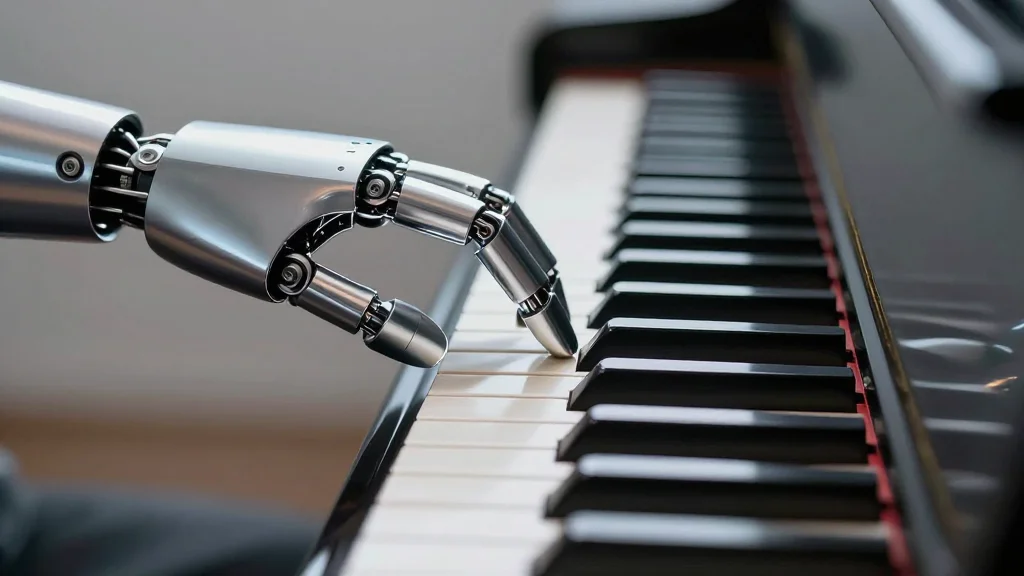
Robot Learns to Play Music by Ear, Opening New Possibilities in Medicine and Therapy
Why It Matters
The breakthrough shows robots can acquire complex motor skills with minimal data, paving the way for personalized, adaptive medical assistive devices. It shifts robotics from rigid programming toward human‑like learning, accelerating therapeutic innovation.
Key Takeaways
- •Musician Hand learns piano in two minutes via motor babbling.
- •Neural network maps sound to tendon‑driven finger motions.
- •Judges could not reliably distinguish robot from human performances.
- •Approach enables exoskeletons that adapt to individual movement patterns.
- •Perceptual robotics may transform stroke and Parkinson’s rehabilitation.
Pulse Analysis
The Musician Hand represents a departure from conventional AI that relies on massive datasets and pre‑programmed instructions. By emulating the infant "motor babbling" stage, the robot gathers sensory feedback during a brief period of random key presses, then uses a compact neural network to translate auditory cues into precise finger movements. This minimalist learning pipeline demonstrates that high‑fidelity motor control can emerge from a few minutes of self‑exploration, challenging the assumption that extensive training is a prerequisite for sophisticated robotic behavior.
In the medical arena, the implications are profound. An exoskeleton built on perceptual‑robotics principles could be fitted to a newly diagnosed Parkinson’s patient, learning the individual's gait and reach within days rather than months of calibration. As the disease progresses, the device would continuously adapt, preserving the wearer’s unique movement signature without costly software updates. Similarly, rehabilitation robots could observe a therapist’s technique, replicate it, and personalize exercises for home use, offering real‑time adjustments based on patient feedback. This adaptive capability promises to reduce therapy costs, increase patient compliance, and improve outcomes for stroke survivors and the elderly.
Beyond healthcare, the technology signals a broader shift toward robots that perceive, experiment, and self‑correct in dynamic environments. Industries such as construction, manufacturing, and logistics could deploy machines that learn site‑specific tasks on the spot, lowering deployment time and increasing safety. However, the rapid learning ability also raises ethical questions about autonomy and accountability, especially when robots perform actions with direct human impact. Ongoing research will need to balance the benefits of adaptive intelligence with robust oversight frameworks to ensure trustworthy deployment.
Robot learns to play music by ear, opening new possibilities in medicine and therapy
Comments
Want to join the conversation?
Loading comments...