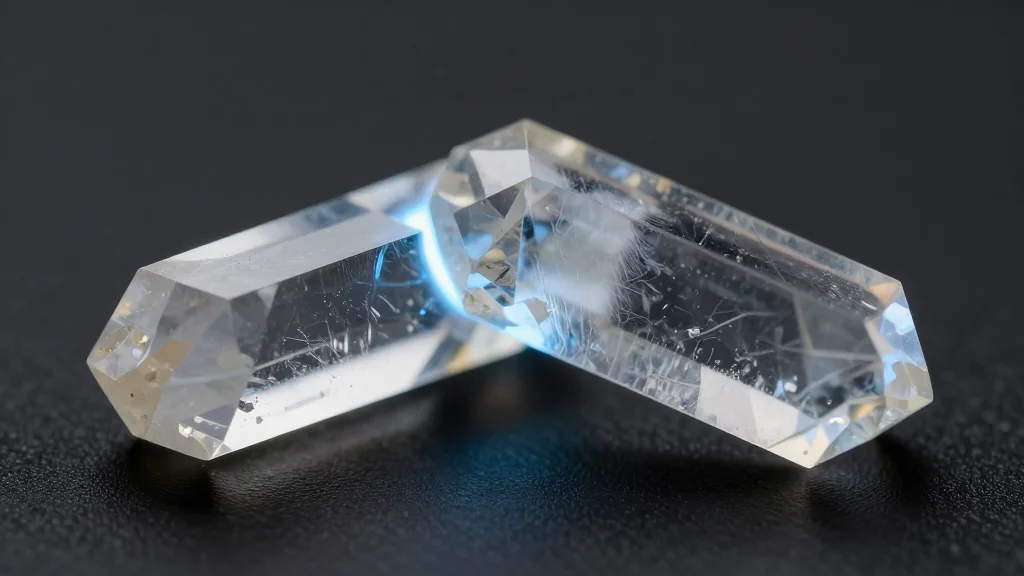
Rotated Lithium Niobate Crystals Unlock Conductive Interfaces in Otherwise Insulating Material
Why It Matters
Engineering conductivity in traditionally insulating crystals could enable ultra‑fast, miniaturized components for AI and quantum processors, expanding the material toolbox for next‑generation electronics.
Key Takeaways
- •Twisted lithium niobate interfaces become highly conductive
- •Conductivity varies with precise crystal rotation angle
- •Technique works beyond van der Waals materials
- •Enables quantum‑grade nanoelectronic components
Pulse Analysis
The concept of ‘twist engineering’ has reshaped condensed‑matter research over the past decade, beginning with graphene’s magic‑angle superconductivity and rapidly expanding to a suite of van der Waals crystals. By rotating atomically thin layers, researchers can tune electronic band structures, creating phenomena that do not exist in the individual constituents. However, this strategy has been largely confined to weakly bonded, easily exfoliated materials. The recent breakthrough from Paderborn University demonstrates that the same principle can be applied to robust, strongly bound crystals such as lithium niobate, a ferroelectric widely used in photonics and acoustic devices.
In the study, two bulk lithium‑niobate wafers were aligned at controlled twist angles and bonded under heat and pressure, a process known as thermal‑compression bonding. Electrical measurements revealed the emergence of narrow, highly conductive channels at the interface, with conductivity peaking at specific angles analogous to the magic‑angle condition in graphene. The researchers attribute this behavior to polar discontinuities and charge redistribution across the twisted ferroelectric layers. Crucially, the effect persists despite the material’s intrinsic insulating nature, proving that twist‑induced electronic reconstruction is not limited to van der Waals systems.
The ability to induce conductivity in a traditionally insulating substrate opens a new design space for quantum and ultra‑fast computing hardware. Engineers could embed conductive pathways directly within ferroelectric substrates, reducing interconnect complexity and enabling tighter integration of logic, memory, and photonic components. Moreover, lithium niobate’s established manufacturing ecosystem means that scaling these twisted interfaces to wafer‑level production may be feasible, accelerating adoption in AI accelerators and quantum processors. Ongoing collaborations across Europe and the United States suggest that further optimization of twist angles and bonding techniques could soon translate laboratory findings into commercial nanoelectronic architectures.
Rotated lithium niobate crystals unlock conductive interfaces in otherwise insulating material
Comments
Want to join the conversation?
Loading comments...