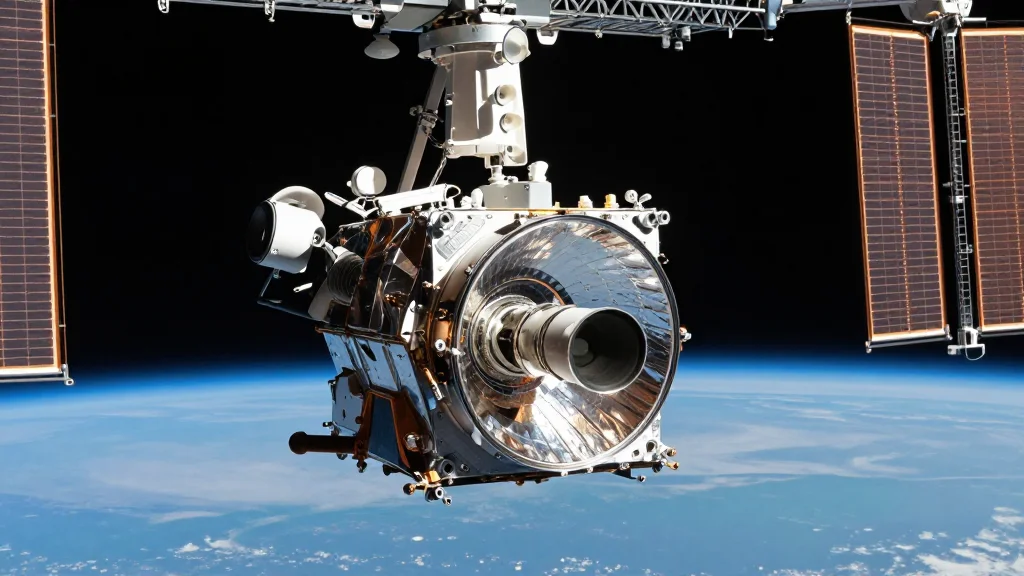
Russian Cosmonauts Install Solar Telescope During ISS Spacewalk
Why It Matters
The solar telescope expands the ISS’s capability to study space‑weather phenomena, directly supporting satellite operators and power‑grid resilience. It also underscores Russia’s ongoing role in multinational orbital research.
Key Takeaways
- •6‑hour EVA by Sergey Kud‑Sverchkov and Sergei Mikaev on May 27
- •Installed a solar telescope to monitor Sun’s activity from ISS
- •Retrieved and repositioned multiple scientific payloads during the spacewalk
- •Telescope will enhance real‑time space‑weather forecasting for Earth
- •Demonstrates continued Russian contribution to ISS research operations
Pulse Analysis
The latest Russian extravehicular activity on the International Space Station highlighted both operational precision and scientific ambition. Over a six‑hour window, cosmonauts Kud‑Sverchkov and Mikaev executed a choreographed series of tasks, from securing the new solar telescope to swapping out aging experiment racks. Their meticulous work, conducted in the harsh vacuum of space, reflects the ISS’s enduring role as a platform for international collaboration and continuous hardware upgrades.
The solar telescope, now affixed to the station’s exterior, is designed to capture high‑resolution images of the Sun’s photosphere and corona. By providing near‑real‑time data on solar flares, coronal mass ejections, and sunspot activity, the instrument will feed critical inputs to space‑weather models used by satellite operators, airlines, and power‑grid managers. This capability is especially valuable as reliance on satellite communications and navigation grows, making accurate forecasting of geomagnetic storms a strategic priority.
Beyond immediate scientific returns, the successful installation reinforces Russia’s technical expertise within the ISS partnership and sets a precedent for future payloads that could be deployed by commercial entities. As the station approaches the end of its current operational lifespan, such upgrades extend its relevance, offering a testbed for next‑generation sensors and fostering a pipeline of data that will inform both governmental and private space endeavors. The EVA thus serves as a microcosm of how incremental hardware enhancements can drive broader advancements across the aerospace ecosystem.
Russian Cosmonauts Install Solar Telescope During ISS Spacewalk
Comments
Want to join the conversation?
Loading comments...