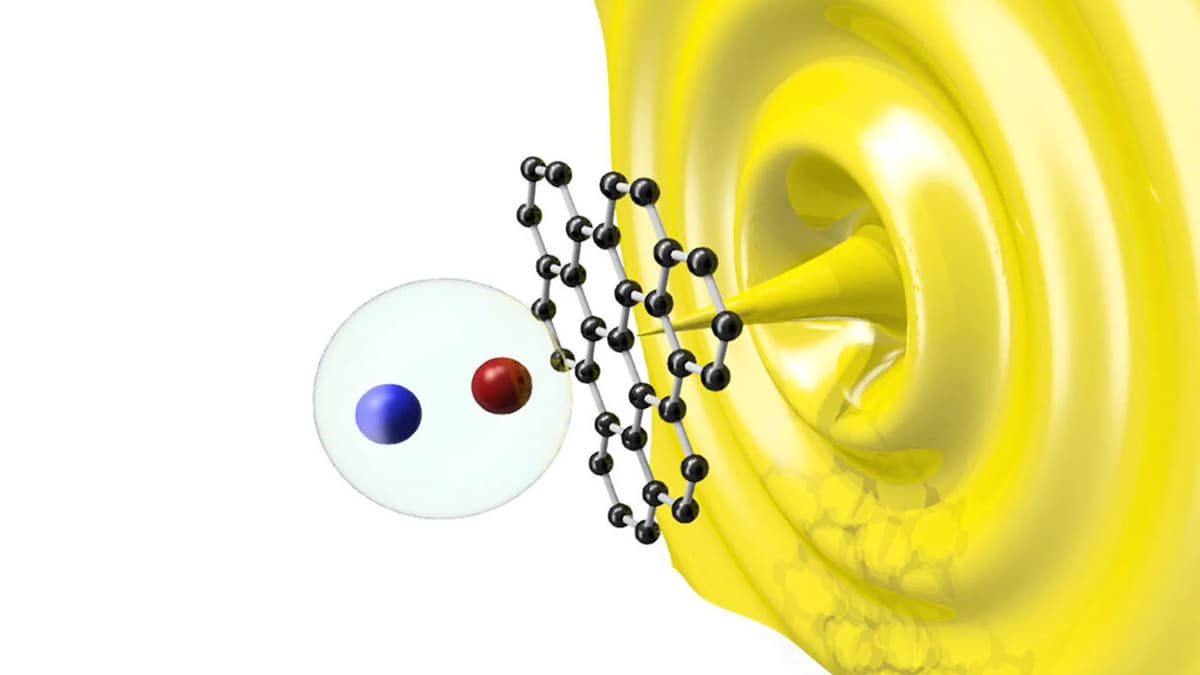
Scientists Catch Antimatter “Atom” Acting Like a Wave for the First Time
Why It Matters
Demonstrating wave‑particle duality for positronium validates a fundamental quantum principle in an antimatter system and paves the way for novel experiments, from non‑destructive material probing to gravity tests on antimatter.
Key Takeaways
- •Positronium beam diffracted through graphene, confirming wave behavior
- •Beam achieved 3.3 keV energy with narrow spread
- •Neutral antimatter atom enables non‑destructive surface analysis
- •Opens path for gravity tests on antimatter
Pulse Analysis
The observation of positronium diffraction marks a milestone in quantum physics, extending the celebrated wave‑particle duality to the simplest atom made of matter and antimatter. While electrons, neutrons and even large molecules have shown interference, positronium’s fleeting lifetime and dual‑mass nature made it a challenging candidate. By engineering a neutral, high‑coherence beam and matching its de Broglie wavelength to the lattice spacing of a graphene membrane, the researchers produced a textbook diffraction pattern, proving that the electron‑positron pair acts as a unified quantum wave rather than two independent particles.
Beyond its fundamental significance, the technique offers practical benefits for materials science. Because positronium carries no net charge, it can probe delicate surfaces—such as insulators, magnetic films, or nanostructured coatings—without the charging effects that plague conventional electron or ion beams. The ultra‑high‑vacuum, graphene‑based setup also demonstrates a scalable platform for precision spectroscopy, potentially enabling measurements of positronium energy levels, lifetimes, and interactions with exotic materials. These capabilities could accelerate the development of antimatter‑based imaging and non‑invasive diagnostics in semiconductor manufacturing and quantum device fabrication.
Looking forward, the ability to manipulate coherent positronium opens a pathway to address one of physics’ lingering questions: how does antimatter respond to gravity? Future interferometry experiments could measure the free‑fall acceleration of positronium with unprecedented accuracy, testing the equivalence principle for lepton‑antilepton systems. Such tests would complement ongoing efforts with antihydrogen and could reveal subtle violations that hint at new physics beyond the Standard Model. The breakthrough thus bridges foundational quantum research with applied antimatter technologies, positioning positronium as a versatile tool for both scientific discovery and industrial innovation.
Scientists catch antimatter “atom” acting like a wave for the first time
Comments
Want to join the conversation?
Loading comments...