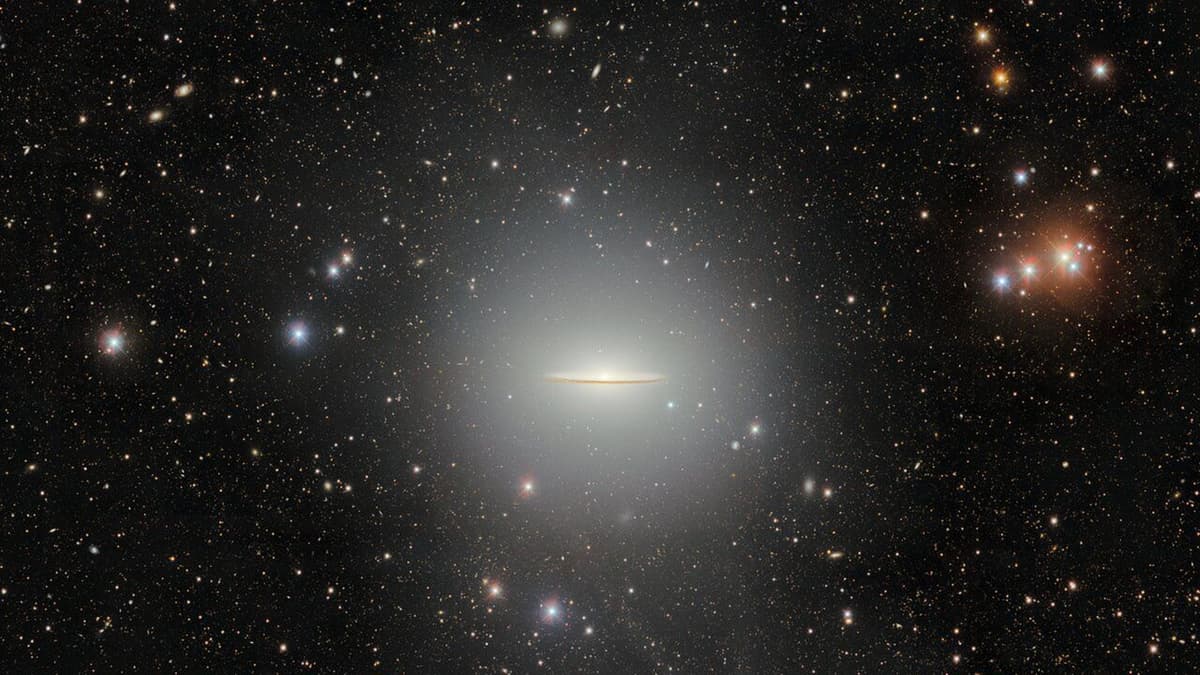
Scientists Detect an Enormous Halo Around the Iconic Sombrero Galaxy — Space Photo of the Week
Companies Mentioned


Why It Matters
The discovery expands our understanding of M104’s mass distribution and merger timeline, offering a rare glimpse into how massive spirals acquire and retain dark‑matter halos.
Key Takeaways
- •Dark Energy Camera captures halo three times galaxy's width
- •Halo reveals extensive dark matter envelope around Sombrero Galaxy
- •Faint stellar stream suggests past satellite merger event
- •Image shows 2,000 globular clusters surrounding bright nucleus
- •Observations complement James Webb mid‑infrared data from 2024‑2025
Pulse Analysis
The new wide‑field image of the Sombrero Galaxy (M104) captured by the Dark Energy Camera (DECam) on the 4‑meter Victor M. Blanco telescope reveals an expansive, diffuse halo that stretches more than three times the diameter of the galaxy’s bright disk. This halo, invisible in earlier observations, consists of extremely faint starlight and likely traces the galaxy’s outermost stellar population and dark‑matter envelope. By mapping such low‑surface‑brightness structures, astronomers gain a more complete picture of the galaxy’s total mass and its gravitational reach.
Along the halo’s edge the DECam exposure also uncovers a thin, curved stellar stream arcing away from the galaxy’s southern side. Such streams are the remnants of dwarf satellites torn apart by tidal forces, and their presence in M104 points to a relatively recent accretion event. This discovery aligns with similar streams identified around the Milky Way and Andromeda, reinforcing the view that massive spirals grow through a series of minor mergers. Analyzing the stream’s orbit and composition will help constrain the timing and mass of the disrupted companion.
The Sombrero halo image demonstrates the power of ground‑based, ultra‑deep surveys to complement space‑based observatories such as the James Webb Space Telescope, which previously imaged M104 in the mid‑infrared. While JWST excels at probing dust‑enshrouded star‑forming regions, DECam’s wide field captures the faint outskirts that trace dark‑matter distribution. Future campaigns that combine infrared, optical, and spectroscopic data will enable three‑dimensional mapping of the galaxy’s halo, refining models of galaxy assembly and offering a benchmark for testing cosmological simulations of halo growth and will inform upcoming surveys like the Vera C. Rubin Observatory.
Scientists detect an enormous halo around the iconic Sombrero Galaxy — Space photo of the week
Comments
Want to join the conversation?
Loading comments...