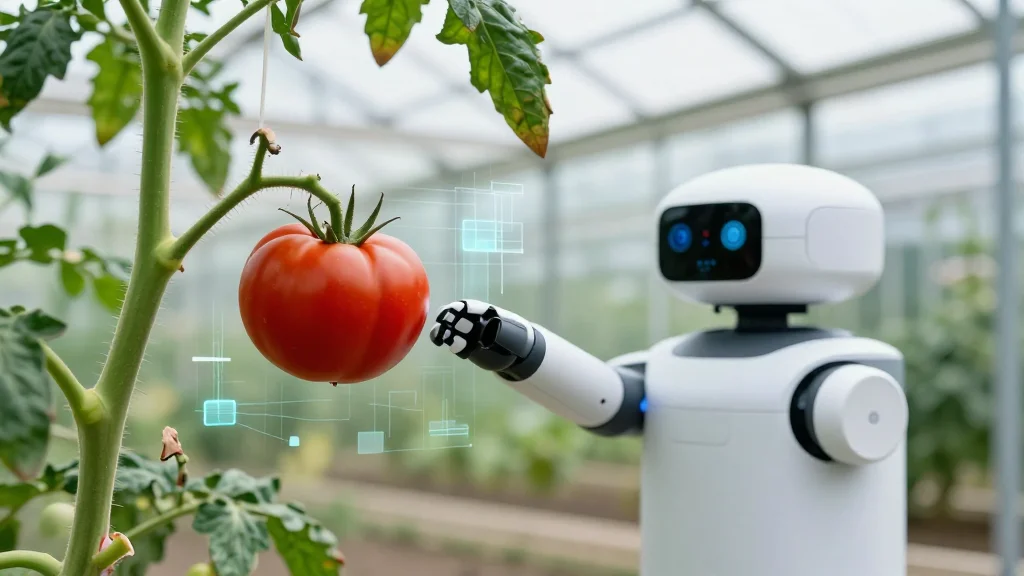
Scientists Develop Virtual Tomato Training Arena for Agricultural Robots
Why It Matters
Automating data generation removes a major bottleneck, accelerating the deployment of harvest robots and lowering costs for growers. The technique is adaptable to other high‑value crops, expanding the impact of AI across agriculture.
Key Takeaways
- •Virtual tomato farms generate labeled images automatically for AI training.
- •3D Gaussian Splatting + Unreal Engine 5 recreates realistic lighting and geometry.
- •Synthetic datasets achieved comparable detection accuracy on real-world tomato images.
- •Method reduces manual labeling time, accelerating robot deployment on farms.
- •Approach can extend to other high-value crops beyond tomatoes.
Pulse Analysis
The agricultural robotics sector has long wrestled with a data dilemma: training object‑detection models requires thousands of meticulously labeled images, a process that is both time‑consuming and costly. By synthesizing a virtual tomato field that mirrors real‑world conditions, Osaka Metropolitan University’s team sidesteps this hurdle. The virtual arena produces endless variations of lighting, leaf overlap, and fruit occlusion, ensuring AI models encounter the full spectrum of scenarios they will face in the field.
At the heart of the system lies a blend of cutting‑edge reconstruction techniques. Using 3D Gaussian Splatting, the researchers capture fine‑grained surface detail and dynamic illumination, then import the models into Unreal Engine 5 for photorealistic rendering. Positional data from the virtual camera automatically generates bounding boxes and ripeness labels in YOLO format, eliminating manual annotation. Early experiments show that models trained on these synthetic datasets detect tomatoes in actual farm images with accuracy rivaling those trained on labor‑intensive real datasets, proving the virtual approach’s viability.
Beyond tomatoes, the methodology offers a scalable blueprint for a wide array of crops where visual variability hampers AI adoption. Faster, cheaper data generation can hasten the rollout of autonomous harvesters, reducing labor shortages and boosting yields for growers. As the technology matures, we can expect broader industry uptake, tighter integration with farm management platforms, and a new wave of AI‑driven precision agriculture solutions that are both economically and environmentally sustainable.
Scientists develop virtual tomato training arena for agricultural robots
Comments
Want to join the conversation?
Loading comments...