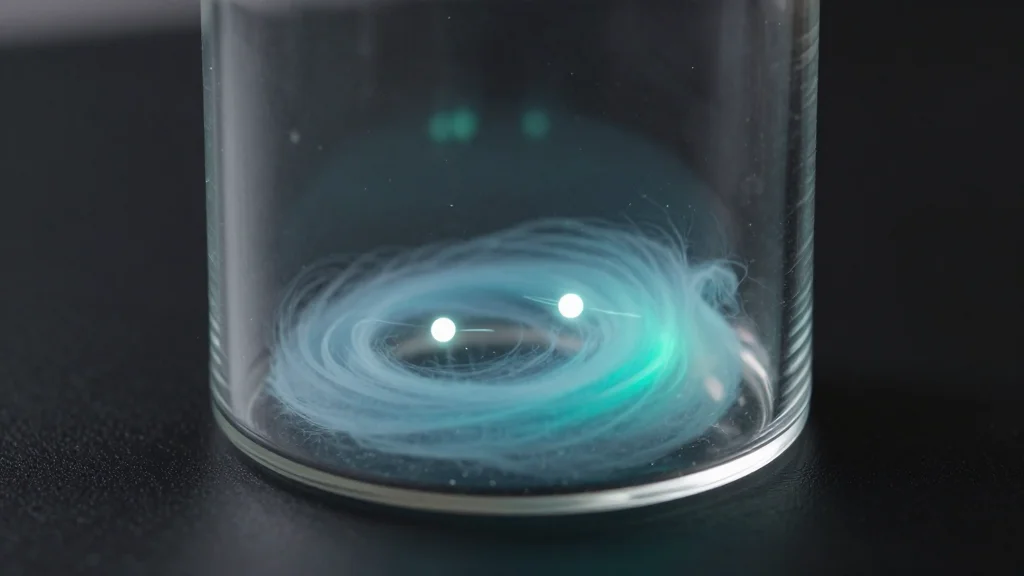
Scientists Directly Image Cooper‑Pair Dynamics, Challenging Decades‑Old Theory

Why It Matters
Directly visualizing Cooper‑pair dynamics resolves a critical blind spot in the foundational BCS theory, confirming that electron pairs influence each other in ways previously only hypothesized. This insight reshapes the theoretical landscape, prompting revisions that could accelerate the discovery of materials capable of superconductivity at practical temperatures. Moreover, the experimental platform demonstrates that ultracold atom systems can serve as precise analogues for solid‑state physics, expanding the toolkit for probing quantum many‑body problems that underpin technologies ranging from quantum computers to lossless power grids. By exposing the missing inter‑pair correlations, the study provides a concrete target for computational models and materials scientists. Incorporating these effects could refine predictions of critical temperatures, electron‑phonon coupling strengths, and other parameters essential for engineering next‑generation superconductors. In a broader sense, the work exemplifies how cross‑disciplinary collaboration—combining experimental finesse with theoretical rigor—can unlock longstanding scientific mysteries.
Key Takeaways
- •First direct imaging of Cooper‑pair dynamics in an ultracold Fermi gas.
- •Observed synchronized inter‑pair motion contradicts BCS assumption of independent pairs.
- •Study published April 15 in Physical Review Letters.
- •Experiment led by Tarik Yefsah (CNRS) and Shiwei Zhang (Flatiron Institute).
- •Findings could inform design of room‑temperature superconductors.
Pulse Analysis
The breakthrough marks a turning point not because it overturns BCS outright, but because it supplies the missing empirical data that theorists have long needed. For decades, the BCS framework has been treated as a near‑axiom, with its limitations accepted as abstract. Now, with a concrete visualization of pair‑pair correlations, the community can move from speculative extensions to data‑driven refinements. This shift mirrors the transition in particle physics when the Higgs boson was finally observed, turning a theoretical construct into a measurable entity.
Historically, progress in superconductivity has alternated between material discovery and theoretical insight. The 1986 discovery of high‑temperature cuprates spurred a flurry of new models, yet none have achieved consensus. The current work offers a unifying experimental anchor that could reconcile disparate theories by showing that the missing piece is not a new exotic interaction but a subtle collective behavior of existing pairs. If computational groups can embed these correlations into density‑functional or quantum‑Monte‑Carlo frameworks, predictive power will increase dramatically.
Looking ahead, the real test will be whether the observed dynamics persist in more complex, solid‑state systems. If they do, the path to room‑temperature superconductors may shift from trial‑and‑error alloying to targeted engineering of inter‑pair coupling. Investors and policymakers should watch for follow‑up studies that apply this imaging technique to candidate materials, as they could accelerate the timeline for commercial breakthroughs in energy transmission and quantum technologies.
Scientists Directly Image Cooper‑Pair Dynamics, Challenging Decades‑Old Theory
Comments
Want to join the conversation?
Loading comments...