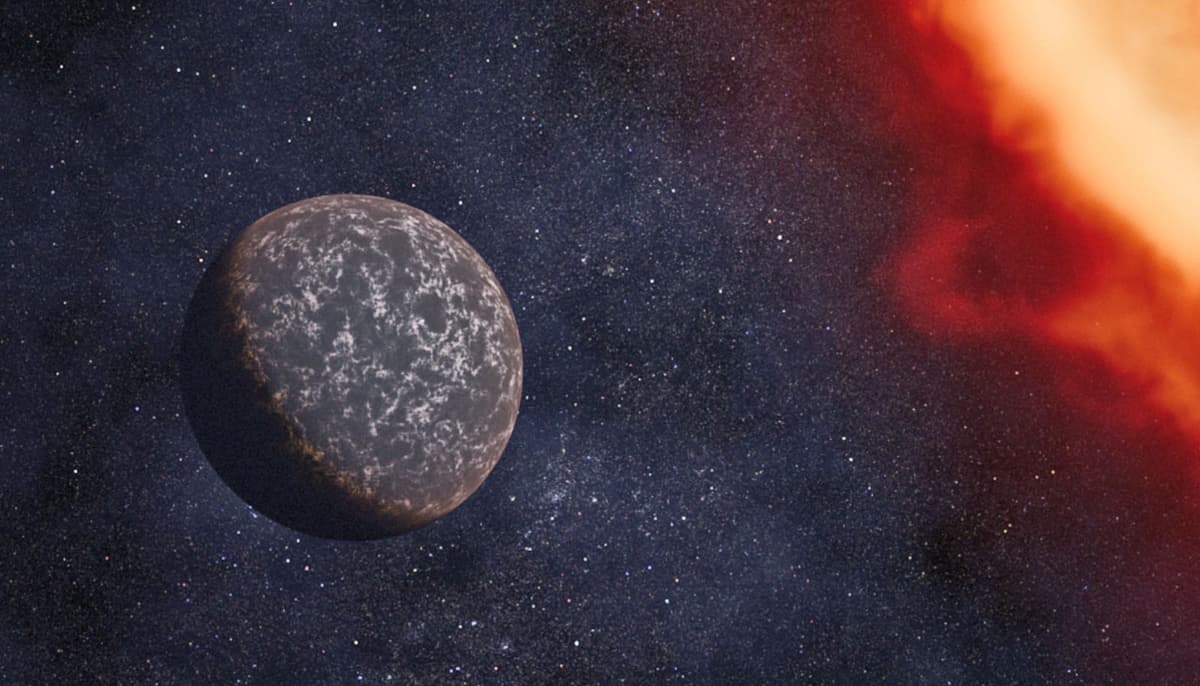
Scientists Get Their Best-Ever Look at Distant Planet’s Surface
Why It Matters
The result provides the first direct constraints on the surface composition of a rocky exoplanet, sharpening models of planet formation and guiding the search for habitable worlds.
Key Takeaways
- •JWST mapped Kua’kua’s surface via secondary eclipse technique.
- •Dark basaltic terrain suggests no plate tectonics or water.
- •Day side reaches ~1,300 °F; night side remains frozen.
- •Study narrows criteria for identifying potentially habitable exoplanets.
Pulse Analysis
The James Webb Space Telescope is redefining exoplanet science by moving beyond bulk measurements to surface‑level characterization. By exploiting the secondary eclipse method—subtracting stellar light when the planet slips behind its star—researchers can isolate the planet’s own emission. This technique, previously limited to large gas giants, now yields high‑resolution thermal maps of a rocky world, demonstrating JWST’s unprecedented sensitivity and spectral coverage.
Kua’kua, formally LHS 3844 b, offers a striking case study. Orbiting a red dwarf at a blistering 0.5‑day period, the planet’s day side soars to roughly 1,300 °F while its night side freezes in perpetual darkness. Spectral analysis shows a featureless, low‑albedo surface best explained by basaltic rock, akin to lunar mare or Mercury’s regolith, and an atmosphere that is either absent or extremely thin. The lack of water‑related minerals and plate‑tectonic signatures suggests a geologically dead world, reinforcing the idea that close‑in rocky planets can lose volatiles early in their evolution.
Beyond the headline, the findings reshape how astronomers prioritize targets in the quest for life. A dark, airless surface reduces the likelihood of stable climates, but the methodology proves that JWST can assess surface composition, temperature gradients, and atmospheric presence for dozens of nearby terrestrial planets. Future observations aim to resolve surface roughness and search for trace gases, turning speculative habitability metrics into empirical data. As the exoplanet catalog swells past 6,000, such detailed case studies will be essential for narrowing the field to worlds that might truly resemble Earth.
Scientists get their best-ever look at distant planet’s surface
Comments
Want to join the conversation?
Loading comments...