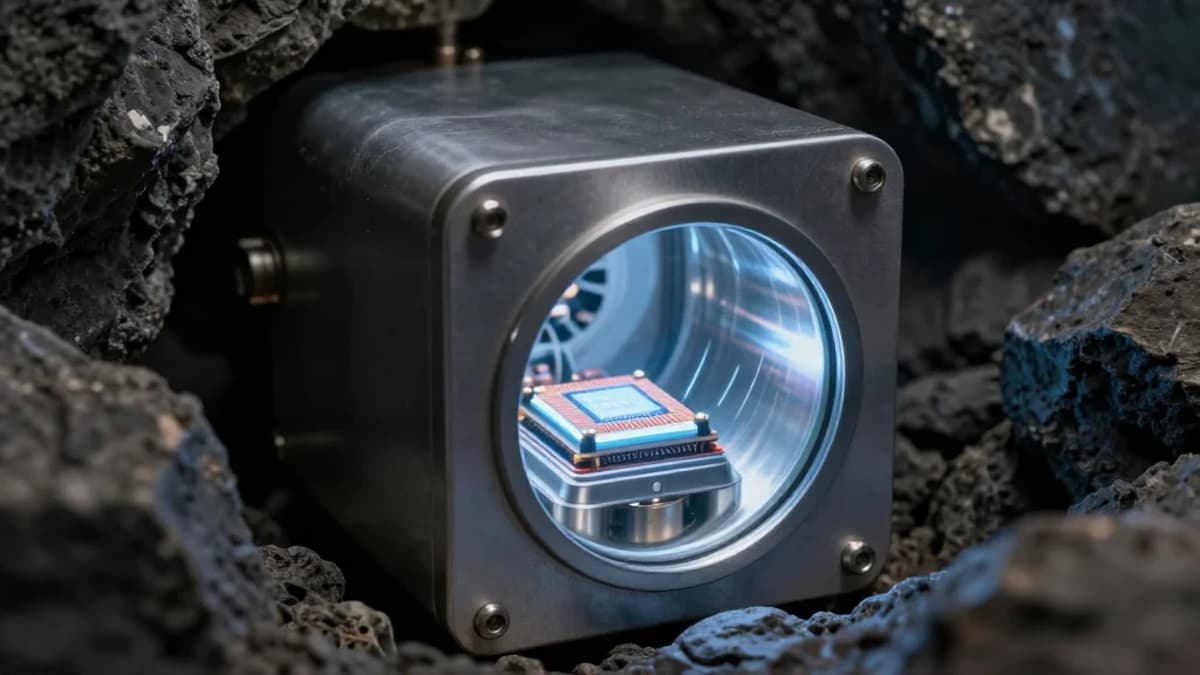
Scientists Head Underground to Measure Effects of Gamma Rays on Superconducting Qubits
•March 10, 2026
0
Why It Matters
Understanding radiation‑induced charge noise is essential for building reliable quantum computers and for using qubits as ultra‑sensitive particle detectors, directly impacting both commercial quantum tech and fundamental physics searches.
Key Takeaways
- •First underground measurement of correlated charge noise in qubits
- •Gamma shielding reduced but did not eliminate charge bursts
- •Residual noise suggests unknown background source near qubits
- •Findings guide error mitigation for quantum computers and detectors
- •Future studies will use SQUAT sensors for higher sensitivity
Pulse Analysis
Locating a superconducting‑qubit chip 350 feet beneath the surface at Fermilab’s NEXUS facility gives researchers a rare view of how ionizing radiation interacts with quantum hardware. By surrounding the dilution refrigerator with a lead shield and toggling it open or closed, the team isolated gamma‑ray‑induced charge bursts from the overwhelming cosmic‑ray background that dominates surface measurements. The experiment marks the first direct observation of correlated charge noise in an underground setting, revealing that even heavily shielded environments still experience sporadic charge events. These measurements also benchmark background models for future underground quantum labs.
Correlated charge noise is a leading source of decoherence in superconducting qubits, directly translating into computational errors. By quantifying how gamma rays trigger simultaneous disturbances across multiple qubits, the study provides concrete data for error‑correction algorithms and hardware‑level mitigation strategies. The findings also inform the design of quantum‑based particle‑physics detectors, where distinguishing genuine dark‑matter signals from radiation‑induced glitches is critical. Engineers can now tailor chip layouts and shielding to suppress these bursts, advancing both scalable quantum computers and ultra‑sensitive quantum sensors.
The collaboration plans follow‑up experiments using SLAC’s superconducting quasiparticle amplifying transmon (SQUAT), which promises higher energy resolution and faster event tagging. Parallel investigations will probe material‑intrinsic radioactivity and long‑lived charge traps that may generate the residual bursts observed even with the shield closed. Backed by the Quantum Science Center and a consortium of universities, these efforts aim to create quantum devices with engineered environmental coupling—minimizing noise for computation while amplifying it for sensing. Such control could accelerate national‑security applications and cement the United States’ leadership in quantum technology.
Scientists head underground to measure effects of gamma rays on superconducting qubits
0
Comments
Want to join the conversation?
Loading comments...