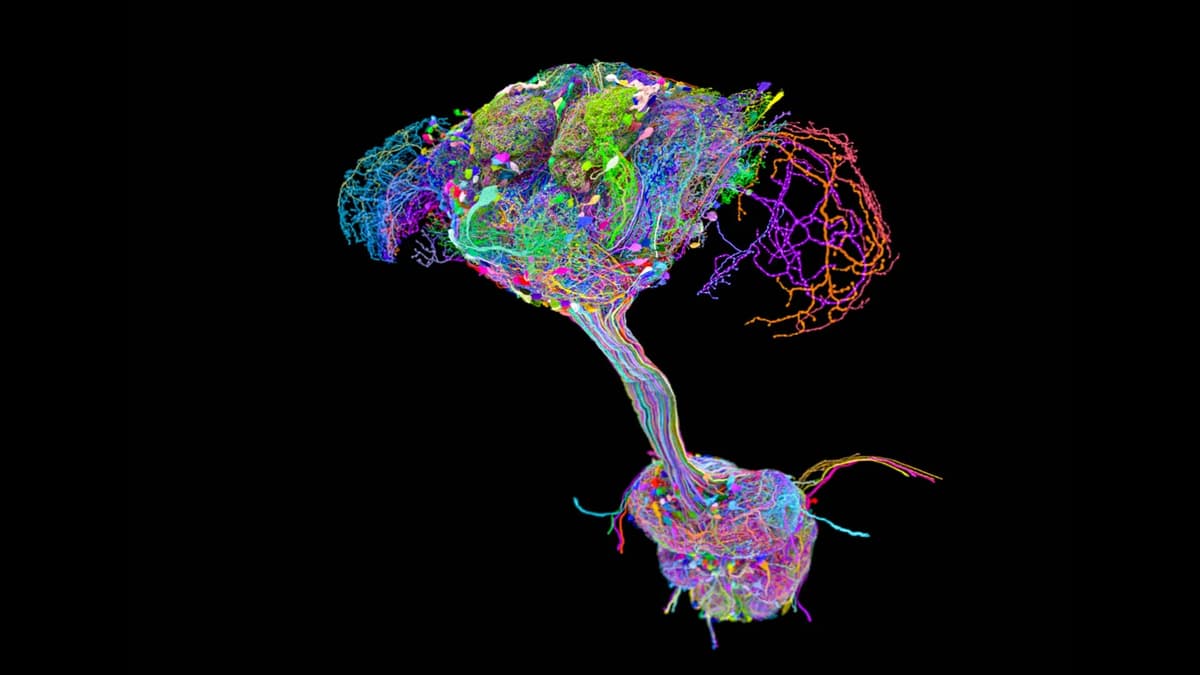
Scientists Mapped Every Neural Connection in a Fruit Fly and Found a Surprise
Companies Mentioned
Why It Matters
By providing a full wiring diagram of a complete nervous system, the study gives scientists a concrete framework to test how brain and body interactions generate behavior, accelerating discovery across neuroscience and AI fields.
Key Takeaways
- •First full fruit‑fly CNS connectome links brain and nerve cord
- •Open dataset enables global researchers to model behavior holistically
- •Study reveals motor control is distributed across local circuits
- •Findings may inform AI designs and cross‑species neural principles
- •Future work will add neuropeptide data and target larger brains
Pulse Analysis
The fruit‑fly connectome represents a technical tour de force, marrying ultra‑high‑resolution electron microscopy with cutting‑edge AI image‑alignment to chart every synapse among roughly 160,000 neurons. By extending the earlier brain‑only map to include the nerve cord, researchers have produced a unified view of the central nervous system that mirrors a biological Google Maps, allowing scientists to trace information flow from sensory input to motor output with unprecedented clarity. The open‑access platform (codex.flywire.ai) democratizes this capability, inviting labs worldwide to generate hypotheses that were previously impossible to test.
Beyond the sheer completeness of the wiring diagram, the data upend a long‑standing assumption that a central brain hub dictates movement. The BANC‑FlyWire team discovered that leg, wing and mouth motions are largely orchestrated by local modules that communicate with neighboring circuits, creating a distributed control architecture. This finding forces a reevaluation of hierarchical models of motor planning and suggests that similar decentralized strategies may underlie more complex organisms. By highlighting how sensory, endocrine and motor pathways intertwine at the circuit level, the work provides a template for dissecting behavior in a mechanistic, systems‑level fashion.
The implications stretch into artificial intelligence and robotics, where biologically inspired architectures can improve adaptability and efficiency. Researchers liken the connectome to the Human Genome Project—a foundational resource that will fuel countless downstream applications, from computational modeling of neural dynamics to the design of autonomous agents that emulate insect agility. Future phases aim to annotate neuropeptide signaling and scale the approach to larger brains, leveraging advances in AI, high‑performance computing, and collaborative science. As funding from the BRAIN Initiative and other federal agencies continues, the fruit‑fly map may become the springboard for a new era of whole‑organism neuroscience.
Scientists mapped every neural connection in a fruit fly and found a surprise
Comments
Want to join the conversation?
Loading comments...