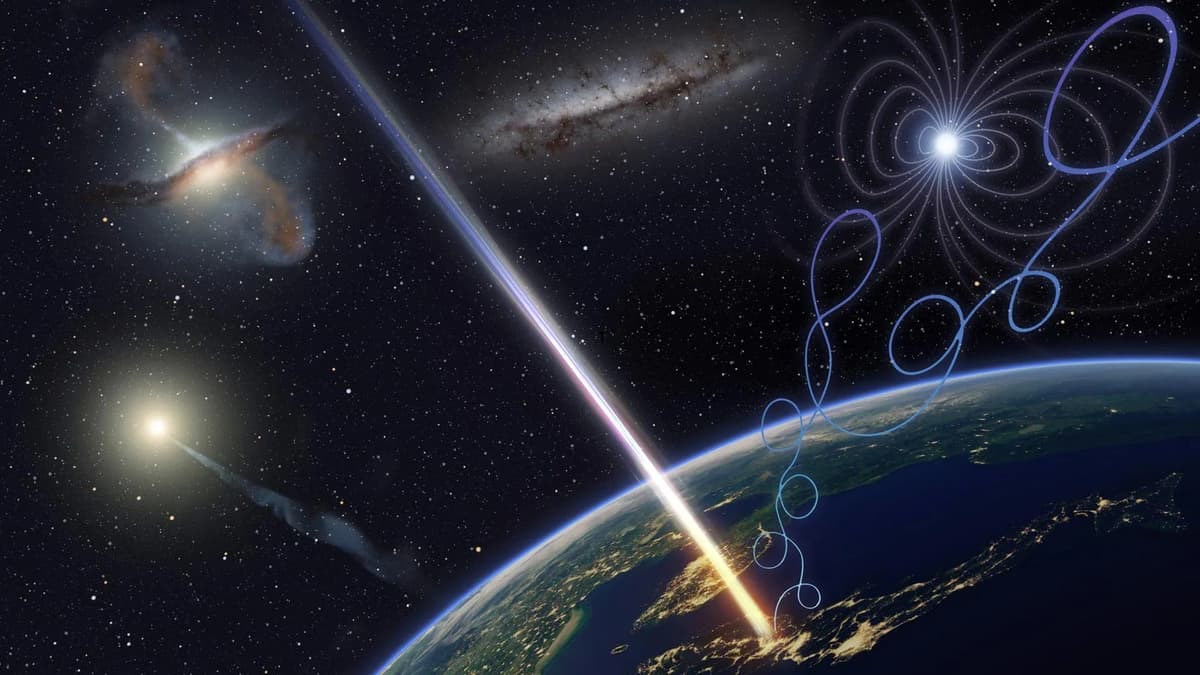
Scientists Think They Solved the Mystery of the Amaterasu Particle
Why It Matters
If ultraheavy nuclei drive the highest‑energy cosmic rays, it reshapes our understanding of cosmic accelerators and informs the design of next‑generation observatories. Identifying the particle composition is essential for pinpointing the astrophysical sources behind these rare events.
Key Takeaways
- •Ultraheavy nuclei may retain energy better than protons across intergalactic space
- •Amaterasu particle’s 240 EeV energy equals kinetic energy of a fast tennis ball
- •Potential sources include neutron‑star mergers, black‑hole collapses, and magnetized neutron stars
- •Simulations set new limits on ultraheavy nuclei’s share of cosmic‑ray population
- •Next‑gen observatories like AugerPrime aim to detect heavy‑nuclei signatures
Pulse Analysis
Ultra‑high‑energy cosmic rays have long puzzled astronomers because their energies dwarf anything produced on Earth. The Amaterasu particle, recorded in Utah in 2021 with an estimated 240 exa‑electron volts, exemplifies this mystery. Traditional models assumed protons or light nuclei, but such particles would shed energy rapidly over billions of light‑years, making their survival unlikely. This discrepancy has driven researchers to explore alternative compositions that could endure the cosmic journey without losing their extreme kinetic punch.
The new Penn State study introduces ultraheavy nuclei—atoms heavier than iron—as viable candidates. By simulating energy loss mechanisms, the team demonstrated that these massive nuclei experience slower degradation, preserving their ultra‑high energies en route to Earth. If a fraction of the observed cosmic‑ray flux consists of such heavy particles, it would shift the search for sources toward the most violent astrophysical phenomena. Collapsing massive stars, magnetized neutron stars, and binary neutron‑star mergers generate the intense magnetic fields and shock fronts needed to accelerate heavy nuclei to exa‑electron‑volt scales, linking cosmic‑ray physics with gravitational‑wave astronomy and gamma‑ray burst studies.
Future observatories are poised to validate the ultraheavy hypothesis. Projects like AugerPrime in Argentina and the proposed Global Cosmic Ray Observatory will enhance composition sensitivity, allowing scientists to differentiate between light and heavy nuclei at the highest energies. Confirming a heavy‑nucleus component would refine models of particle acceleration, improve source localization, and deepen our grasp of the extreme universe. The outcome could also influence particle‑physics theories that rely on cosmic‑ray data to probe physics beyond the Standard Model.
Scientists think they solved the mystery of the Amaterasu particle
Comments
Want to join the conversation?
Loading comments...