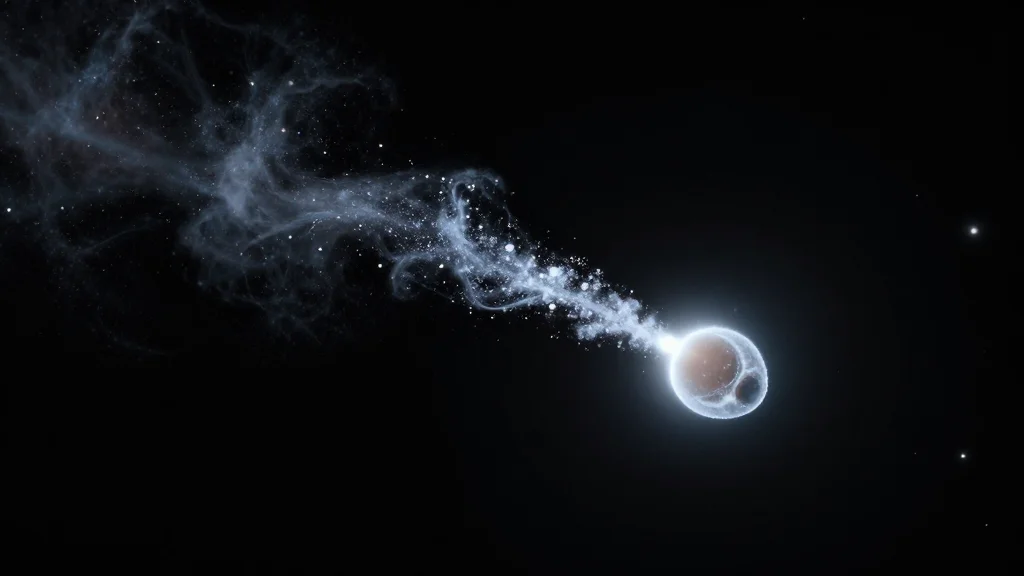
Scientists Trace Latest Interstellar Comet's Home to a Cold, Isolated Corner of the Milky Way
Why It Matters
The discovery provides a rare chemical fingerprint of the earliest planet‑forming environments, refining models of how stars and planets emerged in the galaxy’s cold outskirts. It also demonstrates the growing capability to characterize fleeting interstellar objects before they exit the solar system.
Key Takeaways
- •3I/Atlas is the third confirmed interstellar comet.
- •Deuterium levels suggest origin in a frigid, pre‑stellar cloud.
- •Estimated age up to 11 billion years, older than the Sun.
- •ALMA and Hubble observations pinpointed nucleus size 440 m‑5.6 km.
- •Findings help model planet‑forming environments in early Milky Way.
Pulse Analysis
Interstellar objects have moved from curiosity to scientific goldmines. Since ’Oumuamua’s surprise appearance in 2017 and the cometary visit of 2I/Borisov in 2019, astronomers have sharpened detection networks and coordinated rapid‑response observations. Each visitor offers a snapshot of material forged beyond our solar system, allowing researchers to compare composition, trajectory, and age against native bodies. The growing catalog is reshaping how the community prioritizes telescope time and international collaboration for fleeting cosmic messengers.
The latest entrant, 3I/Atlas, stood out for its extreme deuterium enrichment—a marker of formation in temperatures well below 30 K, typical of dense molecular clouds before any star ignites. ALMA’s millimeter‑wave spectroscopy revealed a deuterium‑to‑hydrogen ratio several times higher than Earth’s oceans, pointing to a birthplace isolated from the heating influence of nearby newborn stars. Coupled with size estimates from Hubble imaging, the data suggest the comet is a relic from the galaxy’s early epochs, possibly 11 billion years old, predating the Sun by a wide margin.
These insights carry weight for planetary science. By linking isotopic signatures to specific galactic environments, researchers can test theories about the distribution of water and organic compounds across the Milky Way. If cold, solitary regions routinely produce water‑rich bodies, they may have seeded nascent planetary systems with the ingredients for life. Future missions, such as the proposed Interstellar Probe, aim to rendezvous with such objects, turning brief fly‑bys into detailed investigations that could rewrite our understanding of planet formation on a galactic scale.
Scientists trace latest interstellar comet's home to a cold, isolated corner of the Milky Way
Comments
Want to join the conversation?
Loading comments...