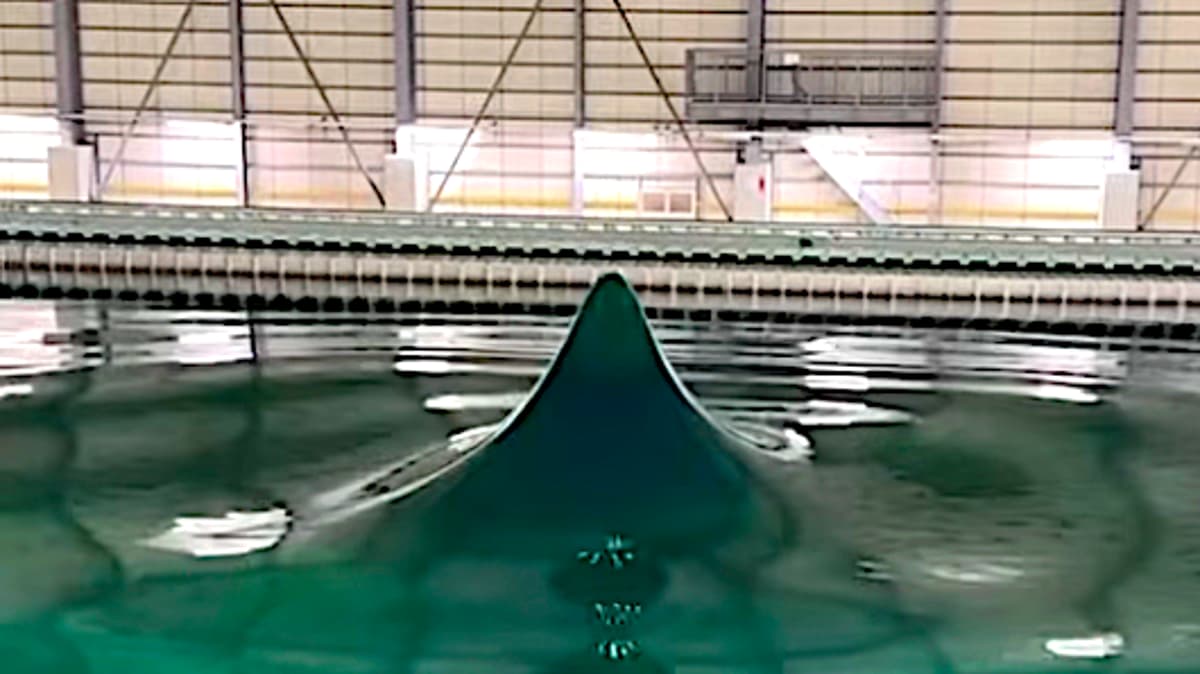
Scientists Unleash Giant ‘Freak Wave’ in Lab Pool and It Erupts Upward (Video)
Why It Matters
The controlled recreation of rogue waves provides actionable data for designing safer offshore platforms, wind turbines, and ships, directly impacting maritime safety and engineering standards.
Key Takeaways
- •Researchers used a circular wave basin with 48 computer-controlled paddles.
- •Wave focusing creates a vertical jet mimicking 65‑foot rogue waves.
- •Facility tests scale models of rigs, turbines, and ships for resilience.
- •Findings help design structures that withstand extreme ocean forces.
- •First lab‑scale visual proof shifts rogue wave study from myth to data.
Pulse Analysis
Rogue waves—sudden, towering walls of water that can exceed 20 meters—have long haunted mariners and skeptics alike. For centuries sailors recounted monstrous swells that capsized ships, but scientific proof remained elusive until a 1995 laser sensor on a North Sea oil rig captured a 65‑foot anomaly. That breakthrough turned folklore into a legitimate field of oceanography, prompting researchers to quantify the physics behind wave focusing, energy concentration, and the rare confluence of factors that generate these extreme events.
In a dedicated engineering laboratory, scientists built a circular wave basin equipped with dozens of computer‑controlled paddles arranged around its perimeter. By synchronizing the paddles, they launch waves that converge at the basin’s center, a technique known as wave focusing. The converging energy forces the water to collapse onto itself and erupt upward, producing a vertical jet that visually replicates a 20‑meter‑plus rogue wave. High‑speed cameras capture the fleeting formation, providing the first controlled, repeatable demonstration of the phenomenon that was previously observable only in the open ocean.
The ability to reproduce rogue‑wave dynamics in a lab setting has immediate commercial relevance. Engineers can place scale models of offshore oil platforms, wind turbines, and cargo vessels in the basin to assess structural responses under extreme loading. Data from these tests inform design codes, material selection, and emergency response protocols, ultimately reducing the risk of catastrophic failure during real storms. Moreover, the visual evidence fuels public awareness and supports funding for further research into predictive modeling, which could one day enable ships to avoid dangerous wave clusters before they form.
Scientists Unleash Giant ‘Freak Wave’ in Lab Pool and It Erupts Upward (Video)
Comments
Want to join the conversation?
Loading comments...