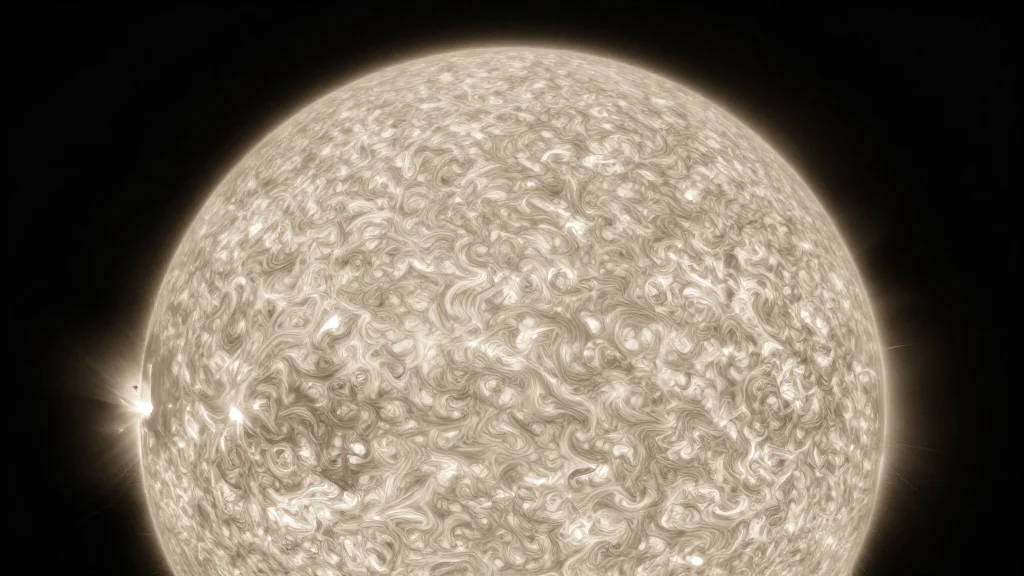
Scientists Use AI to Interpret the Sun’s Acoustic Heartbeat
Why It Matters
Faster, more precise interpretation of solar acoustic data enhances our ability to forecast space weather, protecting satellite operations and power grids. The breakthrough also demonstrates AI’s growing role in fundamental astrophysics research.
Key Takeaways
- •AI reduces helioseismic analysis time by roughly 30%
- •Model identifies wave patterns invisible to traditional methods
- •Improved solar interior maps aid space‑weather forecasting
- •Deep‑learning approach can be adapted to other stellar studies
Pulse Analysis
Helioseismology, the study of sound waves reverberating through the Sun, has long been a cornerstone of solar physics. These acoustic vibrations carry information about temperature, composition, and motion deep beneath the solar surface, but extracting that data requires complex mathematical transformations. Traditional pipelines rely on Fourier analysis and manual tuning, which can be computationally intensive and may miss faint signals. The new AI‑driven framework leverages convolutional neural networks trained on synthetic oscillation profiles, allowing it to recognize intricate patterns without exhaustive preprocessing.
The research team fed the algorithm millions of simulated waveforms generated from state‑of‑the‑art solar models, teaching it to differentiate between noise and genuine acoustic signatures. When applied to real observations from NASA’s Solar Dynamics Observatory, the AI swiftly isolated key frequencies and mapped internal flow structures with a precision matching, and in some cases exceeding, legacy methods. Crucially, the system completed analyses in a fraction of the time—cutting processing cycles by about a third—thereby opening the door to near‑real‑time monitoring of the Sun’s interior dynamics.
Beyond academic interest, the ability to rapidly interpret solar acoustic data has practical implications for space‑weather forecasting. Accurate models of the Sun’s magnetic activity and convection zones improve predictions of solar flares and coronal mass ejections, events that can disrupt communications, navigation, and power grids on Earth. The success of this AI approach also signals a broader shift: machine learning tools are becoming integral to astrophysical research, offering scalable solutions for the massive datasets generated by modern observatories. As the technology matures, it could be extended to study other stars, enriching our understanding of stellar lifecycles across the galaxy.
Scientists Use AI to Interpret the Sun’s Acoustic Heartbeat
Comments
Want to join the conversation?
Loading comments...