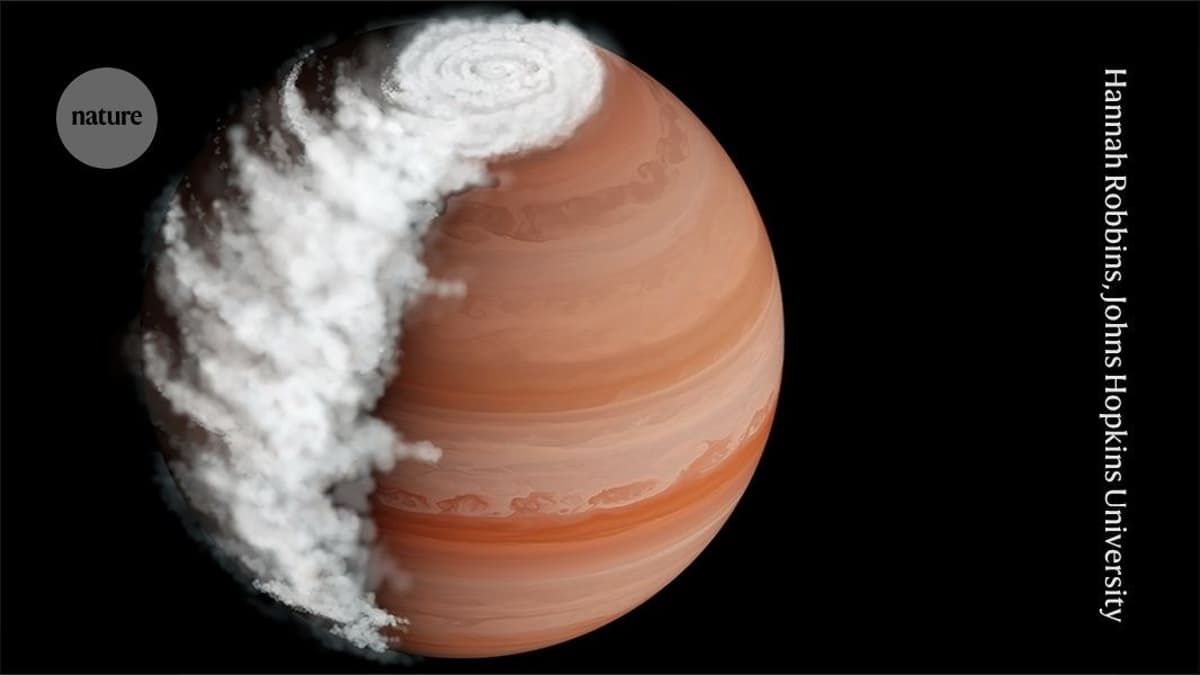
See the Clouds Streaming and Vanishing Around This Planet — 690 Light Years Away
Why It Matters
Mapping cloud dynamics on distant worlds sharpens our grasp of atmospheric chemistry and heat redistribution in extreme exoplanets, improving models that assess habitability and guide future observations.
Key Takeaways
- •JWST detected mineral cloud formation on WASP‑94 A b’s night side
- •Clouds vanish as they cross to the 1,600 K day side
- •Transit spectroscopy revealed spectral asymmetry across the planet’s limb
- •Phase‑resolved observations can map exoplanet weather patterns
- •Findings boost techniques for characterizing hot‑Jupiter atmospheres
Pulse Analysis
The hunt for exoplanet atmospheres has long relied on transit spectroscopy, where a fraction of starlight filters through a planet’s gaseous envelope as it passes in front of its host star. This technique is notoriously difficult because the atmospheric signal is often less than one percent of the total light, demanding instruments with exceptional sensitivity. The James Webb Space Telescope, with its infrared spectrographs and unprecedented stability, has finally provided the precision needed to dissect these faint imprints, opening a new era for detailed weather mapping on worlds far beyond our solar system.
In the recent Science paper, a team led by Sagnick Mukherjee pointed JWST at WASP‑94 A, a bright star 210 parsecs (≈690 light‑years) away, and captured the planet’s transit at multiple phases. The data revealed a clear asymmetry: the leading limb of the planet’s atmosphere was shrouded in thick clouds, likely composed of mineral droplets that condense in the frigid night side, while the trailing limb appeared cloud‑free as it emerged into a scorching 1,600 K day side. This rapid formation‑dissipation cycle suggests powerful eastward winds that transport condensates across the terminator, offering the first direct glimpse of a cloud‑cycle on an exoplanet.
The implications extend well beyond a single hot‑Jupiter. Demonstrating that phase‑resolved spectroscopy can resolve cloud dynamics paves the way for similar studies of smaller, potentially rocky planets where cloud composition may hint at surface conditions or even biosignatures. Future JWST campaigns and upcoming missions like the Atmospheric Remote‑Sensing Infrared Exoplanet Large‑Survey (ARIEL) will likely adopt this approach, refining atmospheric circulation models and improving predictions of temperature gradients. As the exoplanet community builds richer three‑dimensional pictures of alien skies, the line between distant observation and climate science continues to blur, accelerating the search for worlds that might host life.
See the clouds streaming and vanishing around this planet — 690 light years away
Comments
Want to join the conversation?
Loading comments...