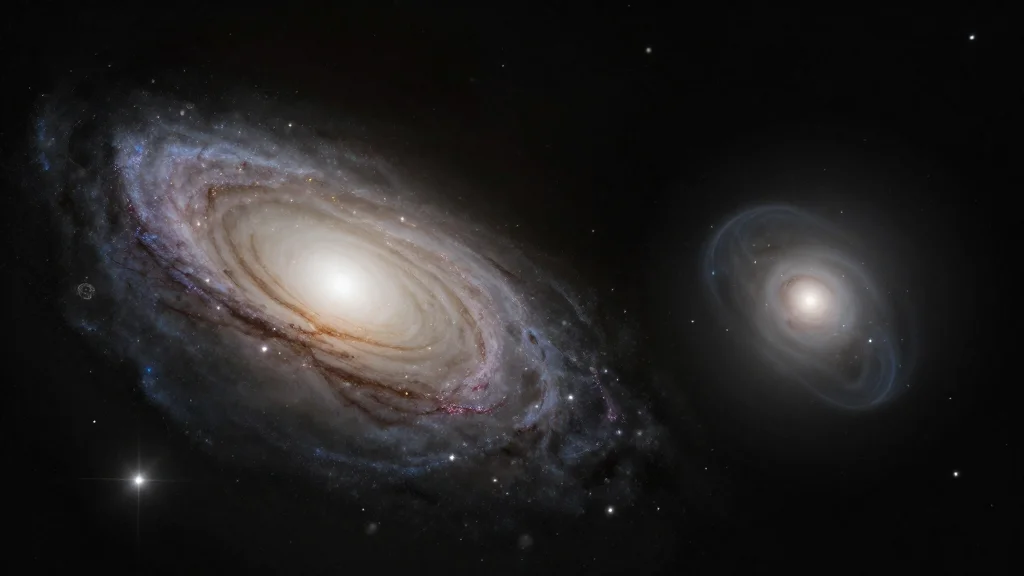
Self-Regulating Process Governs Cosmic Order Inside Star Clusters
Why It Matters
The discovery provides a physics‑based shortcut for modeling star formation, reshaping galaxy‑evolution theory and reducing supercomputing costs.
Key Takeaways
- •Star cluster masses follow self‑regulating optimal sampling.
- •Massive stars only form in large galaxies, not dwarf ones.
- •Entropy‑based model predicts star mass distribution without random sampling.
- •Reduces galaxy‑evolution simulations, saving supercomputing resources.
- •Guides new observational campaigns on non‑random star formation.
Pulse Analysis
The birth of stars within clusters has long been described by the initial mass function, a statistical curve that many assumed emerged from random sampling of gas clouds. Recent work by researchers at Nanjing University and the University of Bonn overturns that notion, showing that the mass of the most massive star is tightly linked to the total mass of its host cluster. By applying Shannon entropy to the formation process, the team demonstrates that star clusters settle into a single, most probable mass distribution, eliminating the need for stochastic fluctuations.
The researchers formalized this behavior as “optimal sampling,” a deterministic rule that maps a cluster’s total mass directly onto a complete stellar mass spectrum. Unlike conventional Monte‑Carlo methods, optimal sampling produces a fixed set of stellar masses with no statistical scatter, mirroring the entropy‑driven equilibrium state identified in the study. This framework explains why dwarf galaxies, whose clusters are modest in mass, never generate stars exceeding a few solar masses, while massive elliptical galaxies can spawn millions of ultra‑bright, short‑lived giants. The result is a predictive, physics‑based tool for astronomers seeking to reconstruct star‑formation histories.
Adopting optimal sampling promises dramatic efficiency gains for large‑scale cosmological simulations. By replacing thousands of stochastic draws with a single mass parameter, researchers can cut supercomputing time and energy consumption by orders of magnitude, accelerating the exploration of galaxy‑formation scenarios. Moreover, the deterministic nature of the model provides clear observational targets: telescopes can now test the predicted absence of massive stars in low‑mass dwarf systems and verify the steep upper‑mass cutoffs in richer clusters. As the community integrates this entropy‑based approach, it is poised to reshape theories of the matter cycle, chemical enrichment, and the luminous evolution of the universe.
Self-regulating process governs cosmic order inside star clusters
Comments
Want to join the conversation?
Loading comments...