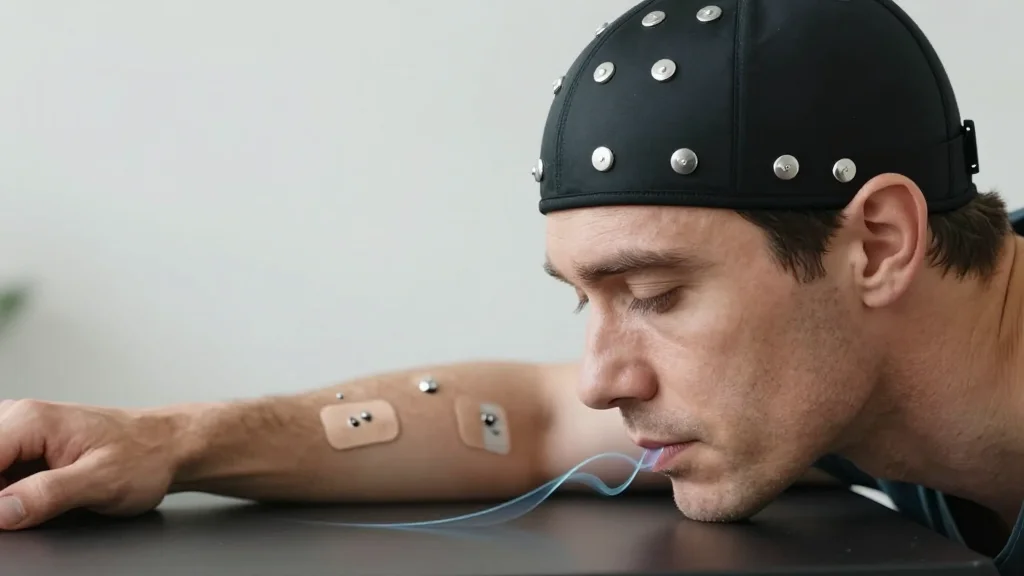
Semantic-Aware Decoding of Covert Inner Speech: A Multimodal EEG–EMG–Audio Framework
Why It Matters
The ability to interpret inner speech from scalp EEG moves non‑invasive BCIs closer to practical communication aids, potentially transforming assistive technology for users unable to speak aloud.
Key Takeaways
- •Overt EEG‑EMG model reaches 54% accuracy on four commands
- •Covert inner‑speech decoding hits 42% accuracy, above chance
- •Semantic alignment links EEG patterns to text embeddings
- •Subject‑held‑out protocol shows need for personalized calibration
- •Multimodal supervision improves non‑invasive BCI performance
Pulse Analysis
Non‑invasive brain‑computer interfaces have long promised a direct link between thought and machine, yet decoding semantic content from scalp recordings remains elusive. Inner speech—silent, self‑generated language—offers a natural communication channel for individuals with speech impairments, but traditional EEG analyses capture only low‑level acoustic features. By integrating electromyography and leveraging multimodal supervision, researchers can enrich the neural signal with peripheral cues, creating a richer latent space that bridges raw brain activity and linguistic meaning.
The study employed a contrastive learning pipeline that first aligned overt EEG‑EMG recordings with audio‑derived sentence embeddings. This supervised alignment taught the model to map neural patterns onto semantic prototypes, enabling it to generalize to covert trials where no sound was produced. Achieving 42% accuracy on a four‑class inner‑speech task—well above random guessing—demonstrates that semantic‑aware training can extract meaningful information from non‑invasive sensors. The subject‑held‑out evaluation underscores the system’s ability to transfer knowledge across users, though variability in individual brain signatures still limits performance.
These results signal a turning point for assistive BCI technology. As calibration protocols become more efficient and datasets expand, semantic decoding could support real‑time command interfaces for smart homes, wheelchair control, or communication apps. Industry players eye the market potential, estimating a multi‑billion‑dollar opportunity in neuro‑assistive devices. Continued research into adaptive models and hybrid sensor arrays will be crucial to bridge the gap between laboratory proof‑of‑concept and reliable, everyday use.
Semantic-Aware Decoding of Covert Inner Speech: A Multimodal EEG–EMG–Audio Framework
Comments
Want to join the conversation?
Loading comments...