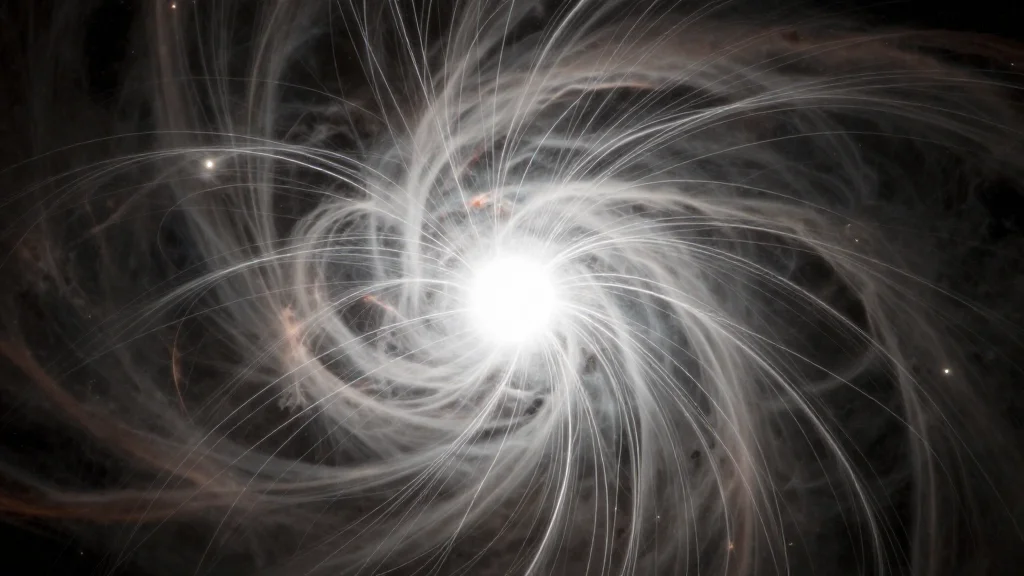
Shock Waves Show How Baby Stars' Cradles Get Their Radial Shape in 3D Simulations
Why It Matters
Understanding the shock‑driven formation of hub‑filament structures clarifies how mass is funneled into stellar nurseries, a key factor in galaxy‑scale star‑formation models. The insight helps astronomers predict where massive stars and clusters will emerge, informing both theory and future observations.
Key Takeaways
- •Oblique shocks reshape magnetic fields, forming radial filaments
- •Dense filaments, not diffuse gas, deliver most mass to star hubs
- •Simulations used ATERUI III supercomputer for 3‑D MHD modeling
- •Shock sources include supernova remnants and radiation‑driven bubbles
- •Future work will vary shock angles, strengths, and cloud geometry
Pulse Analysis
Hub‑and‑spoke patterns, known as hub‑filament systems (HFS), are among the most striking structures observed in star‑forming molecular clouds. Astronomers have long debated how these radial filaments arise, given the chaotic interplay of gravity, turbulence, and magnetic fields. Recent high‑resolution surveys from ALMA and Herschel have catalogued dozens of HFS, revealing that dense filaments consistently converge toward a central hub where protostars ignite. This morphology hints at a coordinated mass‑transport mechanism that could regulate the efficiency of star formation across galactic environments.
The breakthrough comes from a 3‑D magnetohydrodynamic (MHD) simulation run on Japan’s ATERUI III supercomputer. Researchers modeled a cloud with an hourglass‑shaped magnetic field and introduced an external shock mimicking a supernova blast or an expanding ionized bubble. The shock struck the cloud at oblique angles, compressing magnetic field lines and carving invisible channels that guided gas into elongated filaments. These filaments accelerated inward, delivering the majority of mass to the hub while surrounding low‑density gas remained largely static. The results demonstrate that shock‑produced dense filaments, rather than the bulk cloud, dominate mass inflow, offering a physical explanation for the observed few‑percent star‑formation efficiency.
The implications extend beyond a single cloud. By showing that external disturbances can sculpt magnetic topology and drive filament formation, the study provides a framework for linking feedback processes—such as supernovae and massive‑star radiation—to the next generation of star‑forming regions. Future simulations will vary shock direction, strength, and cloud geometry to reproduce the diversity of HFS seen in the Milky Way and other galaxies. This line of inquiry promises to refine models of stellar cluster birth, inform the interpretation of upcoming JWST and SKA observations, and ultimately improve our understanding of how galaxies convert gas into stars.
Shock waves show how baby stars' cradles get their radial shape in 3D simulations
Comments
Want to join the conversation?
Loading comments...