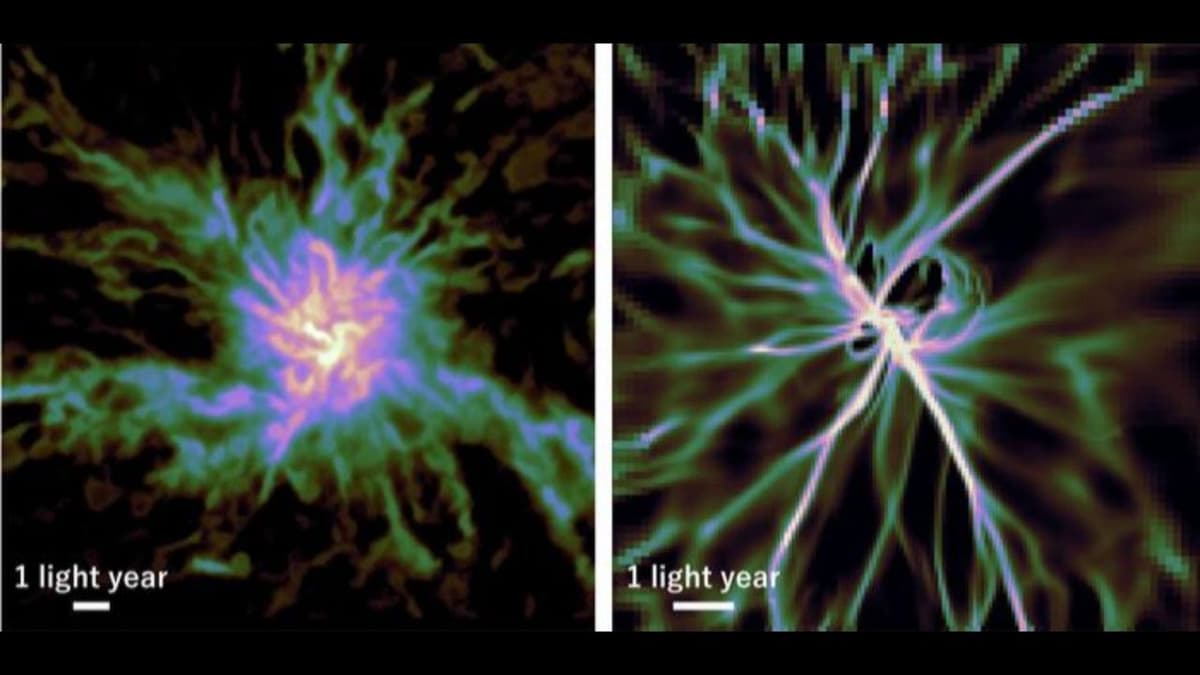
Shockwaves From Dying Stars May Sculpt 'Cosmic Wagon Wheel' Stellar Nurseries, Simulations Reveal
Why It Matters
Understanding how shockwaves shape hub‑filament systems clarifies the efficiency of star formation and improves models of galactic evolution, offering a concrete link between stellar death and birth cycles.
Key Takeaways
- •Shockwaves can sculpt hub‑and‑spoke filaments in molecular clouds
- •Magnetic fields guide gas flow into central star‑forming hubs
- •Simulations on ATERUI III reproduce observed Milky Way hub‑filament patterns
- •Explains why only a small fraction of cloud gas becomes stars
Pulse Analysis
Hub‑filament systems—elongated gas streams radiating toward a dense core—have long fascinated astronomers because they dominate the most active star‑forming regions in our galaxy. While telescopes such as Herschel and Spitzer have mapped dozens of these wheel‑like structures, the physical process that organizes diffuse molecular material into orderly spokes remained speculative. Competing theories invoked gravity alone, turbulence, or magnetic tension, yet none could simultaneously explain the regularity and longevity of the observed patterns.
The new research leverages high‑resolution 3‑D magnetohydrodynamic (MHD) simulations to bridge that gap. By embedding a realistic magnetic field within a virtual molecular cloud and then launching an interstellar shockwave—analogous to a supernova remnant or a powerful stellar wind—the team observed the emergence of oblique shocks that amplified field lines and carved preferential channels. Gas streamed along these magnetically‑guided filaments, accelerating toward a central hub where densities rose enough for gravitational collapse. Running the models on Japan’s ATERUI III supercomputer allowed the authors to follow the evolution over millions of years, producing filamentary networks that match the morphology seen in Milky Way surveys.
The implications extend beyond a tidy explanation of a visual curiosity. By demonstrating that only gas confined to filaments reaches the hub, the study sheds light on why star formation efficiencies in giant molecular clouds are low—most material remains in low‑density inter‑spoke regions. This insight refines theoretical star‑formation rates used in galaxy‑scale simulations and underscores the cyclical nature of the cosmos: the death throes of massive stars seed the conditions for the next generation. Future work will explore varied cloud masses, magnetic strengths, and shock intensities, potentially linking hub‑filament diversity to the birth of massive star clusters and the broader chemical evolution of the Milky Way.
Shockwaves from dying stars may sculpt 'cosmic wagon wheel' stellar nurseries, simulations reveal
Comments
Want to join the conversation?
Loading comments...