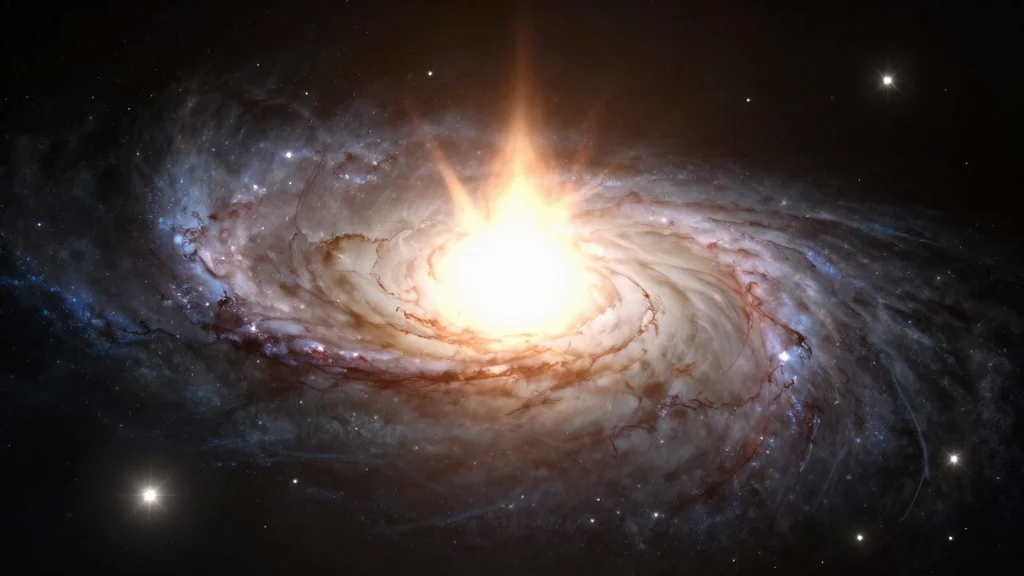
Shredded Star Near Black Hole May Illuminate Entire Galaxy, New Study Finds

Why It Matters
Understanding how tidal disruption events can generate galaxy‑wide light emission reshapes the narrative of black‑hole feeding cycles and their influence on host galaxies. By linking stellar destruction to large‑scale radiative output, the study provides a missing piece in the puzzle of how supermassive black holes regulate star formation and galactic evolution. It also offers a new observational signature for detecting otherwise dormant black holes, expanding the toolkit for high‑energy astrophysics. Beyond pure science, the findings could refine models of cosmic background radiation and inform the search for exotic phenomena such as relativistic jets and high‑energy neutrino sources. If TDEs are confirmed as significant contributors to galactic illumination, they may need to be incorporated into simulations that predict the thermal and ionization state of interstellar media across cosmic time.
Key Takeaways
- •Tidal disruption events can accelerate particles to relativistic speeds, creating shock‑driven radiation.
- •Observations of recent TDEs show emission extending thousands of light‑years, supporting galaxy‑scale illumination.
- •The 2014 G2 encounter with Sagittarius A* highlighted the potential but lacked the expected flare, underscoring the need for refined models.
- •Galaxy‑wide light from TDEs could serve as a new marker for otherwise inactive supermassive black holes.
- •Future missions like JWST and Athena will test the prevalence of TDE‑driven galactic lighting.
Pulse Analysis
The new TDE illumination model arrives at a time when high‑energy astrophysics is seeking fresh pathways to probe black‑hole activity. Historically, the community has focused on accretion‑disk emissions and relativistic jets as the primary signatures of supermassive black holes. By positioning stellar disruption as a galaxy‑scale light source, the study challenges that paradigm and suggests that black holes may influence their environments more diffusely than previously thought.
From a competitive standpoint, the research positions itself against alternative explanations for diffuse galactic X‑ray halos, such as hot gas outflows driven by starburst activity. The authors’ reliance on multi‑wavelength observations strengthens their claim, but the debate will hinge on the ability of upcoming observatories to resolve the spatial extent of TDE‑induced emission. If confirmed, this mechanism could recalibrate estimates of black‑hole feedback efficiency, a key parameter in cosmological simulations that currently rely on coarse approximations.
Looking ahead, the field may see a surge in targeted TDE monitoring campaigns, leveraging time‑domain surveys like LSST to capture the early stages of stellar disruption. Coupled with high‑resolution spectroscopy from JWST and Athena, researchers will be able to map the energy budget from the event’s core out to the galactic outskirts. This integrated approach could finally answer whether shredded stars are rare fireworks or a steady, albeit subtle, source of galactic illumination.
Shredded Star Near Black Hole May Illuminate Entire Galaxy, New Study Finds
Comments
Want to join the conversation?
Loading comments...